Advertisements
Advertisements
Question
A transformer is designed to convert an AC voltage of 220 V to an AC voltage of 12 V. If the input terminals are connected to a DC voltage of 220 V, the transformer usually burns. Explain.
Advertisements
Solution
A transformer is ideally an inductive coil. For an inductor connected across a DC voltage,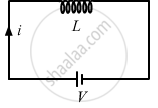
`V - L (di)/(dt) = 0`
`⇒ V = L(di)/(dt)`
⇒ \[\int\limits\] `di = V/L` \[\int\limits\] dt
`⇒ i = (Vt)/L`
For a DC source, the current across the inductor will increase with time and can reach a very large value, which can burn the transformer.
APPEARS IN
RELATED QUESTIONS
A 2 µF capacitor, 100 Ω resistor and 8 H inductor are connected in series with an AC source.
(i) What should be the frequency of the source such that current drawn in the circuit is maximum? What is this frequency called?
(ii) If the peak value of e.m.f. of the source is 200 V, find the maximum current.
(iii) Draw a graph showing variation of amplitude of circuit current with changing frequency of applied voltage in a series LRC circuit for two different values of resistance R1 and R2 (R1 > R2).
(iv) Define the term 'Sharpness of Resonance'. Under what condition, does a circuit become more selective?
A current i1 = i0 sin ωt passes through a resistor of resistance R. How much thermal energy is produced in one time period? A current i2 = −i0 sin ωt passes through the resistor. How much thermal energy is produced in one time period? If i1 and i2 both pass through the resistor simultaneously, how much thermal energy is produced? Is the principle of superposition obeyed in this case?
The dielectric strength of air is 3.0 × 10⁶ V/m. A parallel-plate air-capacitor has area 20 cm2 and plate separation 0.10 mm. Find the maximum rms voltage of an AC source that can be safely connected to this capacitor.
A device Y is connected across an AC source of emf e = e0 sin ωt. The current through Y is given as i = i0 sin (ωt + π/2).
- Identify the device Y and write the expression for its reactance.
- Draw graphs showing a variation of emf and current with time over one cycle of AC for Y.
- How does the reactance of the device Y vary with the frequency of the AC? Show graphically.
- Draw the phasor diagram for device Y.
Average power supplied to a capacitor over one complete cycle is ______.
Explain why the reactance provided by a capacitor to an alternating current decreases with increasing frequency.
In the LCR circuit shown in figure, the ac driving voltage is v = vm sin ωt.
- Write down the equation of motion for q (t).
- At t = t0, the voltage source stops and R is short circuited. Now write down how much energy is stored in each of L and C.
- Describe subsequent motion of charges.

Define Capacitive reactance.
What is the applied voltage at any instant when a capacitor is connected to an AC source?
What does \[t\] represent?
Which relation expresses that the voltage across the capacitor equals the applied voltage?
How does a lamp in series with a capacitor behave after the capacitor charges from a DC source?
What is the capacitive reactance of a \[15.0\,\mu\mathrm{F}\] capacitor connected to a \[50\,\mathrm{Hz}\] source?
What happens to the capacitive reactance if the frequency is doubled while capacitance stays the same?
What happens to the current if the frequency is doubled while the applied voltage and capacitance stay the same?
