Advertisements
Advertisements
प्रश्न
A transformer is designed to convert an AC voltage of 220 V to an AC voltage of 12 V. If the input terminals are connected to a DC voltage of 220 V, the transformer usually burns. Explain.
Advertisements
उत्तर
A transformer is ideally an inductive coil. For an inductor connected across a DC voltage,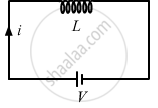
`V - L (di)/(dt) = 0`
`⇒ V = L(di)/(dt)`
⇒ \[\int\limits\] `di = V/L` \[\int\limits\] dt
`⇒ i = (Vt)/L`
For a DC source, the current across the inductor will increase with time and can reach a very large value, which can burn the transformer.
APPEARS IN
संबंधित प्रश्न
When an AC source is connected to a capacitor, there is a steady-state current in the circuit. Does it mean that the charges jump from one plate to the other to complete the circuit?
Is energy produced when a transformer steps up the voltage?
An AC source producing emf ε = ε0 [cos (100 π s−1)t + cos (500 π s−1)t] is connected in series with a capacitor and a resistor. The steady-state current in the circuit is found to be i = i1 cos [(100 π s−1)t + φ1) + i2 cos [(500π s−1)t + ϕ2]. So,
The dielectric strength of air is 3.0 × 10⁶ V/m. A parallel-plate air-capacitor has area 20 cm2 and plate separation 0.10 mm. Find the maximum rms voltage of an AC source that can be safely connected to this capacitor.
A device Y is connected across an AC source of emf e = e0 sin ωt. The current through Y is given as i = i0 sin (ωt + π/2).
- Identify the device Y and write the expression for its reactance.
- Draw graphs showing a variation of emf and current with time over one cycle of AC for Y.
- How does the reactance of the device Y vary with the frequency of the AC? Show graphically.
- Draw the phasor diagram for device Y.
If circuit containing capacitance only, the current ______.
A.C. power is transmitted from a power house at a high voltage as ______.
When an AC voltage of 220 V is applied to the capacitor C ______.
- the maximum voltage between plates is 220 V.
- the current is in phase with the applied voltage.
- the charge on the plates is in phase with the applied voltage.
- power delivered to the capacitor is zero.
Define Capacitive reactance.
A 40 µF capacitor is connected to a 200 V. 50 Hz ac supply. The rms value of the current on the circuit is, nearly ______.
What is the applied voltage at any instant when a capacitor is connected to an AC source?
What instantaneous current results from \[q=Cv_m\sin\omega t\]?
What is the capacitive reactance of a capacitor?
What happens to the current after a capacitor has charged from a DC source?
How does a lamp in series with a capacitor behave when connected to an AC source?
What happens to the capacitive reactance when the capacitance is reduced at a fixed angular frequency?
How does the current in a capacitor connected to an AC source compare in phase with the voltage?
How does inserting an iron rod into the inductor affect its inductive reactance?
