Advertisements
Advertisements
प्रश्न
In the LCR circuit shown in figure, the ac driving voltage is v = vm sin ωt.
- Write down the equation of motion for q (t).
- At t = t0, the voltage source stops and R is short circuited. Now write down how much energy is stored in each of L and C.
- Describe subsequent motion of charges.

Advertisements
उत्तर
i. Consider series LCR circuit and tapping key K to short circuit R. Let i be the current in circuit. Then by Kirchhoff's voltage law, when key K is open.
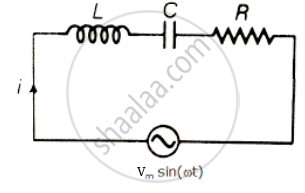
VR+ VL + VC = Vm sin ωt
`iR + L (di(t))/(dt) + (q(t))/C - V_m` sin ωt = 0 .....[∵ i(t) = i = lm sin[ωt + `phi`]
⇒ As charge q(t) changes in circuit with time in AC,
Then `i = (dq(t))/(dt)`
`(di)/(dt) = (d^2q(t))/(dt^2)` .....(Differentiating again)
`R (dq(t))/(dt) + L (d^2q(t))/(dt^2) + (q(t))/C = V_m` sin ωt
`L (d^2q(t))/(dt) + R (dq(t))/(dt) + (q(t))/C = V_m` sin ωt
This is the equation for variation of motion of charge with respect to time.
ii. Let time-dependent charge in circuit is at phase angle with voltage then q = qm cos (ωt + `phi`)
i = `(dq)/(dt) = ω q_m sin (ωt + phi)` ......(I)
`i_m = V_m/Z = V_m/sqrt(R^2 + (X_C - X_L)^2)` ......(II)
`tan phi = (X_C - X_L)/R`
At t = t0, R is short-circuited, then energy stored in L and C, when K is closed will be, `U_L = 1/2 Li` ......(III)
At t = t0
i = im sin (ωt0 + `phi`) ......(IV)
From (II)
`i = V_m/sqrt(R^2 + (X_C - X_L)^2) sin (ωt_0 + phi)` ......(V)
∴ UL = `1/2[V_m/sqrt(R^2 + (X_C - X_L)^2]]^2 sin^2(ωt_0 + phi)`
UC = `q^2/(2C) = 1/(2C) [q_m^2 cos^2 (ωt_0 + pji)]`
Comparing (IV) and (I) Im = qmω
∴ `q_m = i_m/ω`
∴ UC = `1/(2C) * (i_m^2)/ω^2 cos^2 (ωt_0 + phi) = (i_m^2)/(2Cω^2) cos^2 (ωt_0 + phi)`
Using equation (II)
UC = `1/(2Cω^2) [(V_m^2)/(R^2 + (X_C - X_L)^2)]^2 cos^2 (ωt_0 + phi)`
iii. When R is short-circuited, the circuit becomes L-C oscillator. The capacitor will go discharging and all energy will transfer to L and back and forth. Hence there is oscillation of energy from electrostatic to magnetic and vice versa.
APPEARS IN
संबंधित प्रश्न
A 2 µF capacitor, 100 Ω resistor and 8 H inductor are connected in series with an AC source.
(i) What should be the frequency of the source such that current drawn in the circuit is maximum? What is this frequency called?
(ii) If the peak value of e.m.f. of the source is 200 V, find the maximum current.
(iii) Draw a graph showing variation of amplitude of circuit current with changing frequency of applied voltage in a series LRC circuit for two different values of resistance R1 and R2 (R1 > R2).
(iv) Define the term 'Sharpness of Resonance'. Under what condition, does a circuit become more selective?
When an AC source is connected to a capacitor, there is a steady-state current in the circuit. Does it mean that the charges jump from one plate to the other to complete the circuit?
A current i1 = i0 sin ωt passes through a resistor of resistance R. How much thermal energy is produced in one time period? A current i2 = −i0 sin ωt passes through the resistor. How much thermal energy is produced in one time period? If i1 and i2 both pass through the resistor simultaneously, how much thermal energy is produced? Is the principle of superposition obeyed in this case?
Is energy produced when a transformer steps up the voltage?
A transformer is designed to convert an AC voltage of 220 V to an AC voltage of 12 V. If the input terminals are connected to a DC voltage of 220 V, the transformer usually burns. Explain.
The dielectric strength of air is 3.0 × 10⁶ V/m. A parallel-plate air-capacitor has area 20 cm2 and plate separation 0.10 mm. Find the maximum rms voltage of an AC source that can be safely connected to this capacitor.
A transformer has 50 turns in the primary and 100 in the secondary. If the primary is connected to a 220 V DC supply, what will be the voltage across the secondary?
Explain why the reactance provided by a capacitor to an alternating current decreases with increasing frequency.
A 40 µF capacitor is connected to a 200 V. 50 Hz ac supply. The rms value of the current on the circuit is, nearly ______.
In an ac circuit an alternating voltage e = 200\[\sqrt 2\] sin100t volts is connected to capacitor of capacity 1 µF. The r.m.s. value of the current in the circuit is ______.
In an alternating current circuit consisting of elements in series, the current increases on increasing the frequency of supply. Which of the following elements are likely to constitute the circuit?
When an AC voltage of 220 V is applied to the capacitor C ______.
What instantaneous current results from \[q=Cv_m\sin\omega t\]?
What happens to the current after a capacitor has charged from a DC source?
What happens to the capacitive reactance when the capacitance is reduced at a fixed angular frequency?
What happens to the current if the frequency is doubled while the applied voltage and capacitance stay the same?
How does inserting an iron rod into the interior of the inductor affect the inductance of the coil?
