Advertisements
Advertisements
प्रश्न
A device ‘X’ is connected to an a.c source. The variation of voltage, current and power in one complete cycle is shown in figure.
- Which curve shows power consumption over a full cycle?
- What is the average power consumption over a cycle?
- Identify the device ‘X’.

Advertisements
उत्तर
(a) Power is the product of voltage and current (Power = P = VI).
So, the curve of power will be having a maximum amplitude, equal to the product of amplitudes of voltage (V) and current (I) curve. Frequencies, of B and C are equal, therefore they represent V and I curves. So, curve A represents power.
(b) The full cycle of the graph (as shown by the shaded area in the diagram) consists of one positive and one negative symmetrical area.
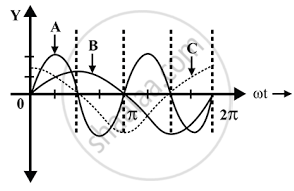
Hence, average power consumption over a cycle is zero.
(c) Here phase difference between V and I is π/2 therefore, the device ‘X’ may be an inductor (L) or capacitor (C) or the series combination of L and C.
APPEARS IN
संबंधित प्रश्न
A 2 µF capacitor, 100 Ω resistor and 8 H inductor are connected in series with an AC source.
(i) What should be the frequency of the source such that current drawn in the circuit is maximum? What is this frequency called?
(ii) If the peak value of e.m.f. of the source is 200 V, find the maximum current.
(iii) Draw a graph showing variation of amplitude of circuit current with changing frequency of applied voltage in a series LRC circuit for two different values of resistance R1 and R2 (R1 > R2).
(iv) Define the term 'Sharpness of Resonance'. Under what condition, does a circuit become more selective?
A current i1 = i0 sin ωt passes through a resistor of resistance R. How much thermal energy is produced in one time period? A current i2 = −i0 sin ωt passes through the resistor. How much thermal energy is produced in one time period? If i1 and i2 both pass through the resistor simultaneously, how much thermal energy is produced? Is the principle of superposition obeyed in this case?
A capacitor acts as an infinite resistance for ______.
A device Y is connected across an AC source of emf e = e0 sin ωt. The current through Y is given as i = i0 sin (ωt + π/2).
- Identify the device Y and write the expression for its reactance.
- Draw graphs showing a variation of emf and current with time over one cycle of AC for Y.
- How does the reactance of the device Y vary with the frequency of the AC? Show graphically.
- Draw the phasor diagram for device Y.
If circuit containing capacitance only, the current ______.
When an ac voltage of 220 V is applied to the capacitor C, then ______.
A capacitor has capacitance C and reactance X, if capacitance and frequency become double, then reactance will be ______.
When an AC voltage of 220 V is applied to the capacitor C ______.
- the maximum voltage between plates is 220 V.
- the current is in phase with the applied voltage.
- the charge on the plates is in phase with the applied voltage.
- power delivered to the capacitor is zero.
Define Capacitive reactance.
What does \[v_m\] represent?
What does \[\omega\] represent?
What does \[t\] represent?
What happens when a DC source is connected to a capacitor?
What happens to the current after a capacitor has charged from a DC source?
What happens to the capacitive reactance if the frequency is doubled while capacitance stays the same?
What happens to the current if the frequency is doubled while the applied voltage and capacitance stay the same?
What happens to the iron when an iron rod is inserted into the interior of an inductor connected to an AC source?
How does inserting an iron rod into the interior of the inductor affect the inductance of the coil?
