Advertisements
Advertisements
प्रश्न
Show that the current leads the voltage in phase by π/2 in an AC circuit containing an ideal capacitor ?
Advertisements
उत्तर
Let us consider a capacitor C connected to an AC source as shown below.
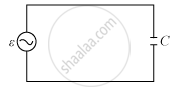
Let the AC voltage applied be
`v = v_msinωt`
`∴ v = q/C`
Applying Kirchhoff’s loop rule, we have:
` v_msinωt q/C`
`i = (dq)/dt`
`∴ i = (d)/dt( v_mCsinωt) `
`ωCv_mcos(ωt)`
`cos ωt = sinωt+π/2`
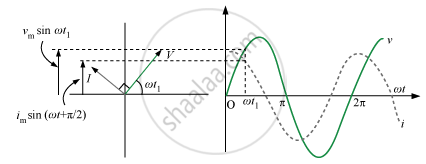
`∴ i = i_msin(ωt+π/2)`
`i_m = ωCv_m`
`i =(v_m)/((1/(ωC)))`
संबंधित प्रश्न
An AC source producing emf ε = ε0 [cos (100 π s−1)t + cos (500 π s−1)t] is connected in series with a capacitor and a resistor. The steady-state current in the circuit is found to be i = i1 cos [(100 π s−1)t + φ1) + i2 cos [(500π s−1)t + ϕ2]. So,
The dielectric strength of air is 3.0 × 10⁶ V/m. A parallel-plate air-capacitor has area 20 cm2 and plate separation 0.10 mm. Find the maximum rms voltage of an AC source that can be safely connected to this capacitor.
A device ‘X’ is connected to an a.c source. The variation of voltage, current and power in one complete cycle is shown in figure.
- Which curve shows power consumption over a full cycle?
- What is the average power consumption over a cycle?
- Identify the device ‘X’.

A 40 µF capacitor is connected to a 200 V. 50 Hz ac supply. The rms value of the current on the circuit is, nearly ______.
In an alternating current circuit consisting of elements in series, the current increases on increasing the frequency of supply. Which of the following elements are likely to constitute the circuit?
When an AC voltage of 220 V is applied to the capacitor C ______.
The resistance of a coil for d.c. is 5 Ω. In a.c., the resistance will ______.
What is the capacitive reactance of a capacitor?
How does inserting an iron rod into the inductor affect its inductive reactance?
