Advertisements
Advertisements
Question
Show that the current leads the voltage in phase by π/2 in an AC circuit containing an ideal capacitor ?
Advertisements
Solution
Let us consider a capacitor C connected to an AC source as shown below.
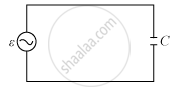
Let the AC voltage applied be
`v = v_msinωt`
`∴ v = q/C`
Applying Kirchhoff’s loop rule, we have:
` v_msinωt q/C`
`i = (dq)/dt`
`∴ i = (d)/dt( v_mCsinωt) `
`ωCv_mcos(ωt)`
`cos ωt = sinωt+π/2`
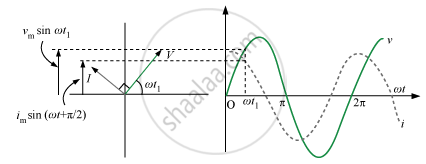
`∴ i = i_msin(ωt+π/2)`
`i_m = ωCv_m`
`i =(v_m)/((1/(ωC)))`
RELATED QUESTIONS
A current i1 = i0 sin ωt passes through a resistor of resistance R. How much thermal energy is produced in one time period? A current i2 = −i0 sin ωt passes through the resistor. How much thermal energy is produced in one time period? If i1 and i2 both pass through the resistor simultaneously, how much thermal energy is produced? Is the principle of superposition obeyed in this case?
Compare resistance and reactance.
Average power supplied to a capacitor over one complete cycle is ______.
When an ac voltage of 220 V is applied to the capacitor C, then ______.
A resistor of 50 Ω, a capacitor of `(25/pi)` µF and an inductor of `(4/pi)` H are connected in series across an ac source whose voltage (in volts) is given by V = 70 sin (100 πt). Calculate:
- the net reactance of the circuit
- the impedance of the circuit
- the effective value of current in the circuit.
What is the capacitive reactance of a capacitor?
What is the average power over one complete cycle for a capacitor connected to an AC source?
How does the current in a capacitor connected to an AC source compare in phase with the voltage?
What happens to the capacitive reactance if the frequency is doubled while capacitance stays the same?
How does inserting an iron rod into the interior of the inductor affect the inductance of the coil?
