Advertisements
Advertisements
प्रश्न
Explain why the reactance provided by a capacitor to an alternating current decreases with increasing frequency.
Advertisements
उत्तर
A capacitor does not allow flow of direct current through it as the resistance across the gap is infinite. When an alternating voltage is applied across the capacitor plates, the plates are alternately charged and discharged. The current through the capacitor is a result of this changing voltage (or charge). Thus, a capacitor will pass more current through it if the voltage is changing at a faster rate, i.e. if the frequency of supply is higher. This implies that the reactance offered by a capacitor is less with increasing frequency; it is given by 1/ωC.
APPEARS IN
संबंधित प्रश्न
Show that the current leads the voltage in phase by π/2 in an AC circuit containing an ideal capacitor ?
A current i1 = i0 sin ωt passes through a resistor of resistance R. How much thermal energy is produced in one time period? A current i2 = −i0 sin ωt passes through the resistor. How much thermal energy is produced in one time period? If i1 and i2 both pass through the resistor simultaneously, how much thermal energy is produced? Is the principle of superposition obeyed in this case?
Is energy produced when a transformer steps up the voltage?
A capacitor acts as an infinite resistance for ______.
An AC source is rated 220 V, 50 Hz. The average voltage is calculated in a time interval of 0.01 s. It
The dielectric strength of air is 3.0 × 10⁶ V/m. A parallel-plate air-capacitor has area 20 cm2 and plate separation 0.10 mm. Find the maximum rms voltage of an AC source that can be safely connected to this capacitor.
A transformer has 50 turns in the primary and 100 in the secondary. If the primary is connected to a 220 V DC supply, what will be the voltage across the secondary?
Define Capacitive reactance.
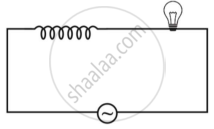
An iron cored coil is connected in series with an electric bulb with an AC source as shown in figure. When iron piece is taken out of the coil, the brightness of the bulb will ______.
A 40 µF capacitor is connected to a 200 V. 50 Hz ac supply. The rms value of the current on the circuit is, nearly ______.
The resistance of a coil for d.c. is 5 Ω. In a.c., the resistance will ______.
What does \[t\] represent?
What is the peak current in a capacitor connected to an AC source?
What happens when a DC source is connected to a capacitor?
Between which values does a current with peak current \[1.47\,\mathrm{A}\] oscillate?
How does inserting an iron rod into the interior of the inductor affect the inductance of the coil?
