Advertisements
Advertisements
Question
State the principle on which transformer works.
Advertisements
Solution
A transformer is a device with the help of which, a given alternating voltage can be increased or decreased to any desired value. The first type of transformer which delivers an output voltage smaller than the input voltage
is called a step down transformer. The second type of transformer which delivers an output voltage larger than the input voltage is called a step up transformer.
Principle of working of a transformer:
A transformer works on the principle that whenever the magnetic flux linked with a coil changes, an emf is induced in the neighbouring coil.
RELATED QUESTIONS
Explain the construction and working of the transformer.
State the principle of the step-down transformer and its working.
How much current is drawn by the primary of a transformer connected to 220 V supply when it delivers power to a 110 V − 550 W refrigerator?
Mention various energy losses in transformer device
Which coil of a step up transformer is made thicker and why?
The following diagram in Fig.10.42 shows a coil of several turns of copper wire connected to a sensitive centre zero galvanometer G near a magnet NS. The coil is free to move in the direction shown in the diagram.
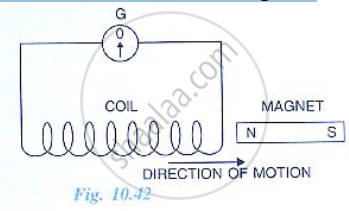
(i) Describe the observation if the coil is rapidly moved.
(ii) How would the observation be altered if (a) the coil has twice as many turns (b the coil was made to move three times as fast?
For what purpose are the transformers used? Can they be used with a direct current source?
The secondary windings of a transformer in which the voltage is stepped down are usually made of thicker wire than the primary. Explain why.
Why is the iron core of a transformer made laminated (thin sheets) instead of being in one solid piece?
The primary coil of a transformed has 800 urns and the secondary coil has 8 turns. It is connected to a 220 V a.c. supply. What will be the output voltage?
Draw a labeled diagram of a full wave rectifier circuit. State its working principle. Show the input-output waveforms ?
What is the turns ratio i.e., transformer ratio, ns: np, in an ideal transformer which in-creases ac voltage from 220 V to 33000 V?
What is a transformer? On what principle does it work?
State the factors on which the frequency of the alternating e.m.f. depends.
Name the principle on which functioning of a transformer depends.
What is the function of a step-up transformer?
Why is the core of a transformer made of soft iron?
(i) Draw a clear labelled diagram of an electric bell.
(ii) Explain in brief, its working.
(iii) What material is used for the core of an electric bell? State the reason.
The power supply to the primary coil of a transformer is 200 W. Find
(i) Current in primary coil if the e.m.f. supply to it is equal to 220V.
(ii) The number of turns in the primary coil is equal to 80 and that in secondary is 800. What is the transformation ratio?
(iii) Name the type of transformer.
(iv) What will be the output voltage?
(v) What is the current in the secondary coil for an ideal transformer?
(vi) What is the output power?
(vii) Is output and input power equal?
(viii) Compare the current flowing in a secondary coil and in a primary coil.
A transformer lowers e.m.f. from 220 V to 15 V. If 400 W power is given in primary, calculate (i) the current in primary coil and (ii) the current in secondary coil.
A transformer lowers e.m.f. from 220 V to 15 V. If the number of turns in primary are 3520, how many turns are in the secondary coil?
The primary and secondary coils of a transformer each have an inductance of 200 x 10-6 H. The mutual inductance between the windings is 4 x 10⁻⁶ H. What percentage of the flux from one coil reaches the other?
A circular coil of 100 turns with a cross-sectional area of 1 m2 is kept with its plane perpendicular to the magnetic field of 1 T. The magnetic flux linkage is ______.
State the mathematical relation between a number of turns in the primary coil to a secondary coil in the step-up transformer.
Distinguish between Step up and Step Down Transformer.
What is Transformer?
Explain step up and step down transformer?
Describe the construction and working of a transformer with a neat labelled diagram.
A step-down transformer reduces the supply voltage from 220 V to 11 V and increase the current from 6 A to 100 A. Then its efficiency is
Give the advantage of AC in long distance power transmission with an illustration.
A 200V/120V step-down transformer of 90% efficiency is connected to an induction stove of resistance 40 Ω. Find the current drawn by the primary of the transformer.
A step-up transformer has 300 turns of primary winding and 450 turns of secondary winding. A primary is connected to 150 V and the current flowing through it is 9A. The current and voltage in the secondary are
The output power in step-up transformer used in practice is ______.
A transformer works on the principle of ______.
For an ideal step-down transformer, the quantity which is constant for both the coils is ______.
A transformer is essentially an a.c. device. It cannot work on d.c. It changes alternating voltages or currents. It does not affect the frequency of a.c. It is based on the phenomenon of mutual induction. A transformer essentially consists of two coils of insulated copper wire having different numbers of turns and wound on the same soft iron core.
The number of turns in the primary and secondary coils of an ideal transformer is 2000 and 50 respectively. The primary coil is connected to a main supply of 120 V and secondary coil is connected to a bulb of resistance 0.6 Ω.
The value of current in the bulb is ______.
Name one electrical device which works on Faraday's law of electromagnetic induction principle.
A step down transformer connected to an ac mains supply of 220 V is made to operate at 11 V, 44 W lamp. Ignoring power losses in the transformer, what is the current in the primary circuit?
Electrical energy is transmitted over large distances at high alternating voltages. Which of the following statements is (are) correct?
- For a given power level, there is a lower current.
- Lower current implies less power loss.
- Transmission lines can be made thinner.
- It is easy to reduce the voltage at the receiving end using step-down transformers.
For an LCR circuit, the power transferred from the driving source to the driven oscillator is P = I2Z cos φ.
- Here, the power factor cos φ ≥ 0, P ≥ 0.
- The driving force can give no energy to the oscillator (P = 0) in some cases.
- The driving force cannot syphon out (P < 0) the energy out of oscillator.
- The driving force can take away energy out of the oscillator.
Draw the effective equivalent circuit of the circuit shown in figure, at very high frequencies and find the effective impedance.

A transformer operating at primary voltage 8 kV and secondary voltage 160 V serves a load of 80 kW. Assuming the transformer to be ideal with purely resistive load and working on unity power factor, the loads in the primary and secondary circuit would be:
An iron rod is placed parallel to magnetic field of intensity 2000 Am-1. The magnetic flux through the rod is 6 × 10⁻⁴ Wb and its cross-sectional area is 3 cm2. The magnetic permeability of the rod in Wb A-1m-1 is ______.
Magnetic flux passing through a coil is initially 4 × 10⁻⁴ Wb. It reduces to 10% of its original value in t second. If the emf induced is 0. 72 mV then t in second is ______.
The large scale transmission of electrical energy over long distances is done with the use of transformers. The voltage output of the generator is stepped-up because of ______.
The self-inductance of a closely wound coil of 200 turns is 10 mH. Determine the value of magnetic flux through the cross-section of the coil when the current passing through the coil is 4 mA.
The primary coil of a transformer has 60 turns whereas its secondary coil has 3000 turns.
If a current of 5A flows in the primary coil, how much current will flow in a load in the secondary coil? State the assumption you have made regarding the transformer, in this calculation.
Derive the equation for a transformer.
In an ideal transformer, the turns ratio is \[\frac {N_p}{N_s}\] = \[\frac {1}{2}\]. The ratio Vs : Vp is equal to (the symbols carry their usual meaning) ______.
A 12 V, 60 W lamp is connected to a 220 V AC supply using an ideal transformer. Find the primary current.
In an ideal transformer, the turns ratio is `N_p/N_s = 1/2`. The ratio Vs : Vp is equal to (the symbols carry their usual meaning):
What are the three main components of a transformer?
How is the laminated soft iron core made?
Which loss is reduced by laminations in the core?
