Advertisements
Advertisements
प्रश्न
State the principle on which transformer works.
Advertisements
उत्तर
A transformer is a device with the help of which, a given alternating voltage can be increased or decreased to any desired value. The first type of transformer which delivers an output voltage smaller than the input voltage
is called a step down transformer. The second type of transformer which delivers an output voltage larger than the input voltage is called a step up transformer.
Principle of working of a transformer:
A transformer works on the principle that whenever the magnetic flux linked with a coil changes, an emf is induced in the neighbouring coil.
संबंधित प्रश्न
Draw a labeled diagram of a step-down transformer.
A group of students while coming from the school noticed a box marked "Danger H.T. 2200 V" at a substation in the main street. They did not understand the utility of a such a high voltage, while they argued, the supply was only 220 V. They asked their teacher this question the next day. The teacher thought it to be an important question and therefore explained to the whole class.
Answer the following questions:
(i) What device is used to bring the high voltage down to low voltage of a.c. current and what is the principle of its working ?
(ii) Is it possible to use this device for bringing down the high dc voltage to the low voltage? Explain
(iii) Write the values displayed by the students and the teacher.
A transformer converts 240 V AC to 60 V AC. The secondary has 75 turns. The number of turns in primary are _______.
(A) 600
(B) 500
(C) 400
(D) 300
Express the turn ratio in terms of voltages.
State the principle of transformer working with the help of a diagram
The primary coil of an ideal step-up transformer has 100 turns and the transformation ratio is also 100. The input voltage and power are 220 V and 1100 W, respectively. Calculate the
(a) number of turns in secondary
(b) current in the primary
(c) a voltage across secondary
(d) current in secondary
(e) power in secondary
Why is the core of a transformer laminated?
You are required to make an electromagnet from a soft iron bar by using a cell, an insulated coil of copper wire and a switch. (a) Draw a circuit diagram to represent the process. (b) label the poles of the electromagnet.
Explain the significance of Lenz’s law to show the conservation of energy in electromagnetic induction.
The following diagram in Fig.10.42 shows a coil of several turns of copper wire connected to a sensitive centre zero galvanometer G near a magnet NS. The coil is free to move in the direction shown in the diagram.
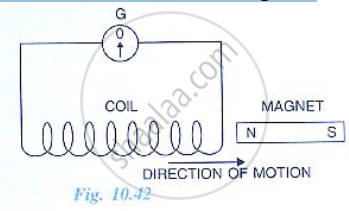
(i) Describe the observation if the coil is rapidly moved.
(ii) How would the observation be altered if (a) the coil has twice as many turns (b the coil was made to move three times as fast?
Name two kind of energy loss in a transformer. How is it minimized?
The primary coil of a transformed has 800 urns and the secondary coil has 8 turns. It is connected to a 220 V a.c. supply. What will be the output voltage?
Given the input current 15 A and the input voltage of 100 V for a step-up transformer having 90% efficiency, find the output power and the voltage in the secondary if the output current is 3 A.
State the principle of working of a transformer. Can a transformer be used to step up or step down a d.c. voltage? Justify your answer.
A transformer is used to step up an alternating emf of 200V to 440V. If the primary coil has 1000 turns, calculate the number of turns in the secondary coil.
The input and output voltages of a transformer are 220 V and 44V respectively. Find the current in input circuit if the output current is 2 A.
In an ideal transformer, an output of 66 kV is required when an input voltage of 220 V is available. If the primary has 300 turns, how many turns should the secondary have?
Can a transformer be used with direct current source? Give reason.
Applying e.m. f to primary coil is 210 V. If the number of turns in primary coil is 200 turns and that of in secondary coil is 20 turns, then find out the output voltage. Name the type of transformer.
An ideal transformer has 100 turns in the primary and 250 turns in the secondary. The peak value of the AC is 28 V. The rms secondary voltage is nearest to ______
Distinguish between Step up and Step Down Transformer.
Explain step up and step down transformer?
The primary of a transformer has 40 turns and works on 100 V and 100 W. Find a number of turns in the secondary to step up the voltage to 400 V. Also calculate the current in the secondary and primary.
Assertion: A transfonner cannot work on D.C. supply.
Reason: D.C. changes neither in magnitude nor in direction.
Which among the following, is not a cause for power loss in a transformer?
A transformer is essentially an a.c. device. It cannot work on d.c. It changes alternating voltages or currents. It does not affect the frequency of a.c. It is based on the phenomenon of mutual induction. A transformer essentially consists of two coils of insulated copper wire having different numbers of turns and wound on the same soft iron core.
The number of turns in the primary and secondary coils of an ideal transformer is 2000 and 50 respectively. The primary coil is connected to a main supply of 120 V and secondary coil is connected to a bulb of resistance 0.6 Ω.
The value of voltage across the secondary coil is ______.
Name one electrical device which works on Faraday's law of electromagnetic induction principle.
A step-down transformer connected to an ac mains supply of 220 V is made to operate at 11 V, 44 W lamp. Ignoring power losses in the transformer, what is the current in the primary circuit?
A transformer consisting of 300 turns in the primary and 150 turns in the secondary gives output power of 2.2 kW. If the current in the secondary coil is 10 A, then the input voltage and current in the primary coil are ______.
An ideal transformer converts 220 V a.c. to 3.3 kV a.c. to transmit a power of 4.4 kW. If primary coil has 600 turns, then alternating current in secondary coil is ______.
An iron rod is placed parallel to magnetic field of intensity 2000 Am-1. The magnetic flux through the rod is 6 × 10⁻⁴ Wb and its cross-sectional area is 3 cm2. The magnetic permeability of the rod in Wb A-1m-1 is ______.
The primary coil of a transformer has 60 turns whereas its secondary coil has 3000 turns.
If a current of 5A flows in the primary coil, how much current will flow in a load in the secondary coil? State the assumption you have made regarding the transformer, in this calculation.
Derive the equation for a transformer.
What type of transformer is used in a mobile phone charger?
Explain why core of a transformer is always laminated.
For what purpose are the transformers used?
How do the input and output powers in a transformer compare? State the assumption made.
In an ideal transformer, the turns ratio is \[\frac {N_p}{N_s}\] = \[\frac {1}{2}\]. The ratio Vs : Vp is equal to (the symbols carry their usual meaning) ______.
A step down transformer connected to an AC mains supply of 220 V is made to operate at 11 V, 44 W lamp. Ignoring power losses in the transformer, what is the current in the primary circuit?
In an ideal transformer, the turns ratio is `N_p/N_s = 1/2`. The ratio Vs : Vp is equal to (the symbols carry their usual meaning):
What are the three main components of a transformer?
What does the laminated soft iron core provide for the flux?
What does the primary coil draw from the source?
What does the secondary coil deliver to the circuit?
What is the induced EMF in the primary coil?
What is the induced EMF in the secondary coil?
