Advertisements
Advertisements
प्रश्न
Explain why core of a transformer is always laminated.
Advertisements
उत्तर
The core of a transformer is always laminated to reduce the loss of power/energy due to eddy currents.
APPEARS IN
संबंधित प्रश्न
The following diagram in Fig.10.42 shows a coil of several turns of copper wire connected to a sensitive centre zero galvanometer G near a magnet NS. The coil is free to move in the direction shown in the diagram.
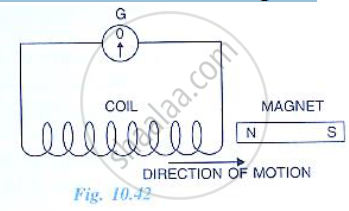
(i) Describe the observation if the coil is rapidly moved.
(ii) How would the observation be altered if (a) the coil has twice as many turns (b the coil was made to move three times as fast?
A transformer is designed to work from a 240 V a.c. mains and to give a supply of 8 V to ring a house bell. The primary coil has 4800 turns. How many turns will be in the secondary coil?
Describe briefly and two energy losses, giving the reasons for their occurrence in actual transformers ?
The input and output voltages of a transformer are 220 V and 44V respectively. Find the current in input circuit if the output current is 2 A.
The primary and secondary coils of a transformer each have an inductance of 200 x 10-6 H. The mutual inductance between the windings is 4 x 10⁻⁶ H. What percentage of the flux from one coil reaches the other?
A step-down transformer reduces the supply voltage from 220 V to 11 V and increase the current from 6 A to 100 A. Then its efficiency is
A transformer having efficiency of 80% is working on 200 V and 6 kW power supply. If the current in the secondary coil is 6 A, the voltage across the secondary coil and the current in the primary coil respectively are ____________.
An iron rod of 0.2 cm2 cross-sectional area is subjected to a magnetising field of 1200 Am-1. If the susceptibility of iron is 599, then the magnetic flux produced is ______.
On which principle is a transformer based?
How is the laminated soft iron core made?
