Advertisements
Advertisements
प्रश्न
State the principle of working of a transformer. Can a transformer be used to step up or step down a d.c. voltage? Justify your answer.
Advertisements
उत्तर
The working principle of the transformer is the mutual induction. The magnetic flux linked with the primary winding of the transformer must change, to produce an induced emf in the secondary coil.
Transformers cannot work on DC voltages. If a DC supply is given to the primary coil of a transformer, it produces a steady magnetic flux. So, no emf will be induced in the secondary coil.
APPEARS IN
संबंधित प्रश्न
Write the function of a transformer.
A transformer converts 240 V AC to 60 V AC. The secondary has 75 turns. The number of turns in primary are _______.
(A) 600
(B) 500
(C) 400
(D) 300
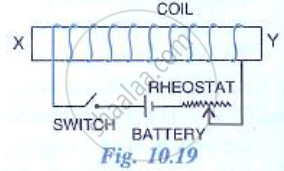
The adjacent diagram shows a coil would around a soft iron bar XY. (a) State the polarity at the end X and Y as the switch is pressed. (b) Suggest one way increasing the strength of electromagnet so formed.
What is a transformer? On what principle does it work?
A 220 V input is supplied to a transformer. The output circuit draws a current of 2.0 A at 440 V. If the ratio of output to input power is 0.8, then the current drawn by primary winding is ______.
Magnetic flux passing through a coil is initially 4 × 10⁻⁴ Wb. It reduces to 10% of its original value in t second. If the emf induced is 0. 72 mV then t in second is ______.
The primary coil having NP turns of an ideal transformer is supplied with an alternating voltage VP. Obtain an expression for the voltage VS induced in its secondary coil having NS turns.
When is an emf induced in the neighbouring coil?
On the basis of winding, what are the two types of transformers?
What does the secondary coil deliver to the circuit?
