Advertisements
Advertisements
Question
Draw a labeled diagram of a full wave rectifier circuit. State its working principle. Show the input-output waveforms ?
Advertisements
Solution
To get an output voltage for both half cycles of the input signal, we use full wave rectifiers. The commonly used full wave rectifier circuits are center-tap rectifier and bridge rectifier. The figure below shows the center-tap rectifier circuit.
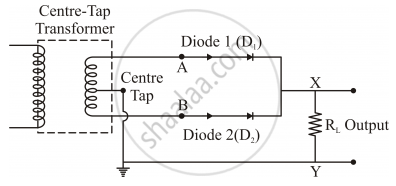
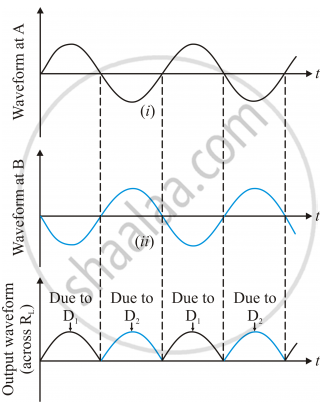
Now consider the circuit. The P-side of the diodes D1 and D2 are connected to the secondary terminals of the transformer. The N-sides of the diodes are connected together. The load is connected between this point and the midpoint of the transformer. When the input signal to diode D1 is positive, it conducts and load current flows. During this time, the input to diode D2 is negative with respect to the midpoint. During the negative half cycle of the input signal, the voltage at D1 is negative and that at D2 is positive. So D2 conducts during this time period. Thus we get output voltage during both the half cycles. As the full wave rectifier rectifies both the half cycles, it is more efficient than the half wave rectifier. The waveforms are given below:
APPEARS IN
RELATED QUESTIONS
State the principle on which transformer works.
Name two factors on which the magnitude of an induced e.m.f. in the secondary coil depends.
How is the e.m.f. across primary and secondary coils of a transformer related with the number of turns of the coil in them?
Explain the significance of Lenz’s law to show the conservation of energy in electromagnetic induction.
For an ideal step-down transformer, the quantity which is constant for both the coils is ______.
Read the following paragraph and answer the question:

Long distance power transmissions
The large-scale transmission and distribution of electrical energy over long distances is done with the use of transformers. The voltage output of the generator is stepped up. It is then transmitted over long distances to an area sub-station near the consumers. There the voltage is stepped down. It is further stepped down at distributing sub-stations and utility poles before a power supply of 240 V reaches our homes.
A power transmission line feeds input power at 2300 V to a step down transformer with its primary windings having 4000 turns. The number of turns in the secondary in order to get output power at 230 V are ______.
The large scale transmission of electrical energy over long distances is done with the use of transformers. The voltage output of the generator is stepped-up because of ______.
Efficiency of transformer is the ratio of ______.
The primary coil of a transformer has 60 turns whereas its secondary coil has 3000 turns.
If a current of 5A flows in the primary coil, how much current will flow in a load in the secondary coil? State the assumption you have made regarding the transformer, in this calculation.
