Advertisements
Advertisements
प्रश्न
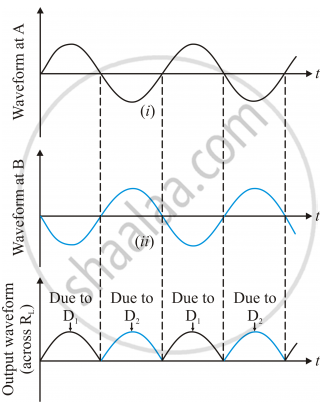
Draw a labeled diagram of a full wave rectifier circuit. State its working principle. Show the input-output waveforms ?
Advertisements
उत्तर
To get an output voltage for both half cycles of the input signal, we use full wave rectifiers. The commonly used full wave rectifier circuits are center-tap rectifier and bridge rectifier. The figure below shows the center-tap rectifier circuit.
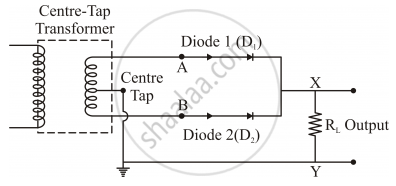
Now consider the circuit. The P-side of the diodes D1 and D2 are connected to the secondary terminals of the transformer. The N-sides of the diodes are connected together. The load is connected between this point and the midpoint of the transformer. When the input signal to diode D1 is positive, it conducts and load current flows. During this time, the input to diode D2 is negative with respect to the midpoint. During the negative half cycle of the input signal, the voltage at D1 is negative and that at D2 is positive. So D2 conducts during this time period. Thus we get output voltage during both the half cycles. As the full wave rectifier rectifies both the half cycles, it is more efficient than the half wave rectifier. The waveforms are given below:
APPEARS IN
संबंधित प्रश्न
The primary coil of an ideal step-up transformer has 100 turns and the transformation ratio is also 100. The input voltage and power are 220 V and 1100 W, respectively. Calculate the
(a) number of turns in secondary
(b) current in the primary
(c) a voltage across secondary
(d) current in secondary
(e) power in secondary
On which type of current do transformers work?
The transformer is used in ______ current circuits.
Describe, with the help of a suitable diagram, the working principle of a step-up transformer. Obtain the relation between input and output voltages in terms of the number of turns of primary and secondary windings and the currents in the input and output circuits.
State the principle of a step-up transformer. Explain, with the help of a labeled diagram, its working ?
What is a transformer? On what principle does it work?
A transformer lowers e.m.f. from 220 V to 15 V. If 400 W power is given in primary, calculate (i) the current in primary coil and (ii) the current in secondary coil.
Explain step up and step down transformer?
A transformer having efficiency of 80% is working on 200 V and 6 kW power supply. If the current in the secondary coil is 6 A, the voltage across the secondary coil and the current in the primary coil respectively are ____________.
A transformer operating at primary voltage 8 kV and secondary voltage 160 V serves a load of 80 kW. Assuming the transformer to be ideal with purely resistive load and working on unity power factor, the loads in the primary and secondary circuit would be:
