Advertisements
Advertisements
Question
A transformer lowers e.m.f. from 220 V to 15 V. If 400 W power is given in primary, calculate (i) the current in primary coil and (ii) the current in secondary coil.
Advertisements
Solution
(i) We know that Power = Ip × Ep
or 400 = Ip × 220
∴ Ip = 1.8 A
(ii) Using Ip × Ep = Is × Es
∴ `"I"_"s" = ("I"_"p" xx "E"_"p")/"E"_"s"`
`"I"_"s" = (1.8 xx 220)/15`
= 26.4 A.
RELATED QUESTIONS
On which type of current do transformers work?
The following diagram in Fig. 10.44 shows a coil X connected to a sensitive centre –zero galvanometer G and a coil P connected to a battery through a switch S.
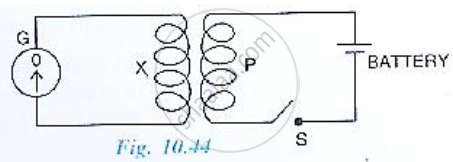
(a) Describe the observation when the switch S is (i) closed suddenly, (ii) then kept closed, (iii) finally opened.
(b) Name and state the law which explains the above observations.
What is the function of a step-up transformer?
Devices which is used to convert high alternating current to low alternating current is ______.
State whether true or false. If false, correct the statement.
A transformer can step up direct current.
A 220 V input is supplied to a transformer. The output circuit draws a current of 2.0 A at 440 V. If the ratio of output to input power is 0.8, then the current drawn by primary winding is ______.
A transformer operating at primary voltage 8 kV and secondary voltage 160 V serves a load of 80 kW. Assuming the transformer to be ideal with purely resistive load and working on unity power factor, the loads in the primary and secondary circuit would be:
A step down transformer connected to an ac mains supply of 220 V is made to operate at 11 V, 44 W lamp. Ignoring power losses in the transformer, what is the current in the primary circuit?
In an ideal transformer, the turns ratio is `N_p/N_s = 1/2`. The ratio Vs : Vp is equal to (the symbols carry their usual meaning):
Which description of the secondary coil is correct?
