Advertisements
Advertisements
Question
Explain the construction of transformer.
Advertisements
Solution
Principle:
The principle of a transformer is the mutual induction between two coils. That is, when an electric current passing through a coil changes with time, an emf is induced in the neighbouring coil.

Construction of transformer
Construction:
- In the simple construction of transformers, there are two coils of high mutual inductance wound over the same transformer core.
- The core is generally laminated and is made up of a good magnetic material like silicon steel. Coils are electrically insulated but magnetically linked via transformer core.
- The coil across which alternating voltage is applied is called primary coil P and the coil from which output power is drawn out is called secondary coil S.
- The assembled core and coils are kept in a container which is filled with suitable medium for better insulation and cooling purpose.
APPEARS IN
RELATED QUESTIONS
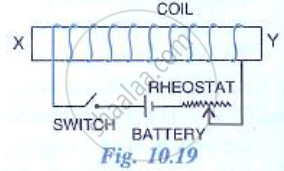
The adjacent diagram shows a coil would around a soft iron bar XY. (a) State the polarity at the end X and Y as the switch is pressed. (b) Suggest one way increasing the strength of electromagnet so formed.
State the principle of a step-up transformer. Explain, with the help of a labeled diagram, its working ?
State the principle of a transformer.
A transformer is essentially an a.c. device. It cannot work on d.c. It changes alternating voltages or currents. It does not affect the frequency of a.c. It is based on the phenomenon of mutual induction. A transformer essentially consists of two coils of insulated copper wire having different numbers of turns and wound on the same soft iron core.
The number of turns in the primary and secondary coils of an ideal transformer is 2000 and 50 respectively. The primary coil is connected to a main supply of 120 V and secondary coil is connected to a bulb of resistance 0.6 Ω.
The value of voltage across the secondary coil is ______.
The magnetic flux through a coil perpendicular to its plane is varying according to the relation Φ = (5t3 + 4t2 + 2t - 5) Weber. If the resistant of the coil is 5 ohm, then the induced current through the coil at t = 2 sec will be ______.
The self-inductance of a closely wound coil of 200 turns is 10 mH. Determine the value of magnetic flux through the cross-section of the coil when the current passing through the coil is 4 mA.
On which principle is a transformer based?
Which winding is the input coil connected to the AC source?
Which winding is the output coil connected to the load?
