Advertisements
Advertisements
Question
Draw the effective equivalent circuit of the circuit shown in figure, at very high frequencies and find the effective impedance.

Advertisements
Solution
The element with infinite resistance will be considered as open circuit and the element with zero resistance will be considered as short-circuited.
In similar way, `X_C = 1/(2pivC)`
At high frequency, XC will be low.
So reactance of capacitance can be considered negligible and capacitor can be considered as short-circuited.
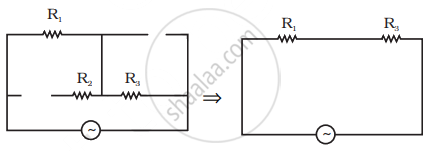
Here the above figure is equivalent circuit to given circuit.
Total impedance,Z = R1 + R3
APPEARS IN
RELATED QUESTIONS
The primary coil of an ideal step-up transformer has 100 turns and the transformation ratio is also 100. The input voltage and power are 220 V and 1100 W, respectively. Calculate the
(a) number of turns in secondary
(b) current in the primary
(c) a voltage across secondary
(d) current in secondary
(e) power in secondary
Which coil of a step up transformer is made thicker and why?
The secondary windings of a transformer in which the voltage is stepped down are usually made of thicker wire than the primary. Explain why.
An a.c generator generates an emf 'ε' where ε = 314 Sin (50πt) volt. Calculate the frequency of emf ε.
Applying e.m. f to primary coil is 210 V. If the number of turns in primary coil is 200 turns and that of in secondary coil is 20 turns, then find out the output voltage. Name the type of transformer.
Explain step up and step down transformer?
The primary of a transformer has 40 turns and works on 100 V and 100 W. Find a number of turns in the secondary to step up the voltage to 400 V. Also calculate the current in the secondary and primary.
State whether true or false. If false, correct the statement.
A transformer can step up direct current.
A step-down transformer reduces the supply voltage from 220 V to 11 V and increase the current from 6 A to 100 A. Then its efficiency is
The 300 turn primary of a transformer has resistance 0.82 Ω and the resistance of its secondary of 1200 turns is 6.2 Ω. Find the voltage across the primary if the power output from the secondary at 1600V is 32 kW. Calculate the power losses in both coils when the transformer efficiency is 80%
Name one electrical device which works on Faraday's law of electromagnetic induction principle.
The line that draws power supply to your house from street has ______.
- zero average current.
- 220 V average voltage.
- voltage and current out of phase by 90°.
- voltage and current possibly differing in phase `phi` such that `|phi| < pi/2`.
In a transformer, number of turns in the primary coil are 140 and that in the secondary coil are 280. If current in primary coil is 4 A, then that in the secondary coil is ______.
The magnetic flux through a coil perpendicular to its plane is varying according to the relation Φ = (5t3 + 4t2 + 2t - 5) Weber. If the resistant of the coil is 5 ohm, then the induced current through the coil at t = 2 sec will be ______.
An iron rod is placed parallel to magnetic field of intensity 2000 Am-1. The magnetic flux through the rod is 6 × 10⁻⁴ Wb and its cross-sectional area is 3 cm2. The magnetic permeability of the rod in Wb A-1m-1 is ______.
Mention two main sources of power loss in real transformers.
The large scale transmission of electrical energy over long distances is done with the use of transformers. The voltage output of the generator is stepped-up because of ______.
What type of transformer is used in a mobile phone charger?
What do \[V_s\] and \[V_p\] represent?
