Advertisements
Advertisements
प्रश्न
Draw the effective equivalent circuit of the circuit shown in figure, at very high frequencies and find the effective impedance.

Advertisements
उत्तर
The element with infinite resistance will be considered as open circuit and the element with zero resistance will be considered as short-circuited.
In similar way, `X_C = 1/(2pivC)`
At high frequency, XC will be low.
So reactance of capacitance can be considered negligible and capacitor can be considered as short-circuited.
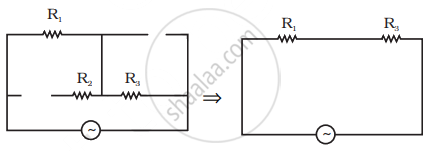
Here the above figure is equivalent circuit to given circuit.
Total impedance,Z = R1 + R3
APPEARS IN
संबंधित प्रश्न
A group of students while coming from the school noticed a box marked "Danger H.T. 2200 V" at a substation in the main street. They did not understand the utility of a such a high voltage, while they argued, the supply was only 220 V. They asked their teacher this question the next day. The teacher thought it to be an important question and therefore explained to the whole class.
Answer the following questions:
(i) What device is used to bring the high voltage down to low voltage of a.c. current and what is the principle of its working ?
(ii) Is it possible to use this device for bringing down the high dc voltage to the low voltage? Explain
(iii) Write the values displayed by the students and the teacher.
A power transmission line feeds input power at 2200 V to a step-down transformer with its primary windings having 300 turns. Find the number of turns in the secondary to get the power output at 220 V.
Why is the core of a transformer laminated?
Mention the two characteristic properties of the material suitable for making core of a transformer.
Name the principle on which functioning of a transformer depends.
State whether true or false. If false, correct the statement.
A transformer can step up direct current.
Explain the working of the transformer.
A step-down transformer connected to the main supply of 220 V is used to operate 11V,88W lamp. Calculate
- Voltage transformation ratio and
- Current in the primary
A 200V/120V step-down transformer of 90% efficiency is connected to an induction stove of resistance 40 Ω. Find the current drawn by the primary of the transformer.
The output power in step-up transformer used in practice is ______.
Assertion: A transfonner cannot work on D.C. supply.
Reason: D.C. changes neither in magnitude nor in direction.
A power transmission line feeds input power at 2300 V to a stepdown transformer with its primary windings having 4000 turns. What should be the number of turns in the secondary in order to get output power at 230 V?
Name one electrical device which works on Faraday's law of electromagnetic induction principle.
The primary winding of a transformer has 100 turns and its secondary winding has 200 turns. The primary is connected to an a.c supply of 120 V and the current flowing in its is 10 A. The voltage and the current in the secondary are ______.
A transformer is used ______
The primary coil of a transformer has 60 turns whereas its secondary coil has 3000 turns.
If a 220 V ac voltage is applied to the primary coil, how much emf is induced in the secondary coil?
A step down transformer connected to an AC mains supply of 220 V is made to operate at 11 V, 44 W lamp. Ignoring power losses in the transformer, what is the current in the primary circuit?
Which winding is the input coil connected to the AC source?
What does the secondary coil deliver to the circuit?
For an ideal transformer with \[\frac{V_s}{V_p}=3\], what is \[\frac{I_p}{I_s}\]?
