Advertisements
Advertisements
प्रश्न
Study the circuits (a) and (b) shown in figure and answer the following questions.
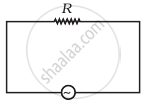 (a) |
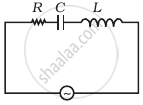 (b) |
- Under which conditions would the rms currents in the two circuits be the same?
- Can the rms current in circuit (b) be larger than that in (a)?
Advertisements
उत्तर
(Irms) in (a) = `V_(rms)/R`
(Irms) in b = `V_(rms)/Z = V_(rms)/sqrt(R^2 + (X_L - X_C))`
(a) (Irms)a = (Irms)b
∴ R = `sqrt(R^2 + (X_L - X_C)^2)`
Squaring both sides
R2 = R2 + (XL – XC)2
Or (XL – XC)2 = 0
XL = XC
(b) For (Irms)b > (Irms)a
`V_(rms)/sqrt(R^2 + (X_L - X_C)^2) > V_(rms)/R`
As Vrms = V so,
`sqrt(R^2 + (X_L - X_C)^2) < R`
Squaring both sides
R2 + (XL – XC)2 < R2
(XL – XC)2 < 0
Square of any number can never be negative. Reactance of XL and XC cannot be negative.
So the rms current in circuit (b) cannot be larger than that in (a).
APPEARS IN
संबंधित प्रश्न
A 100 Ω resistor is connected to a 220 V, 50 Hz ac supply.
- What is the rms value of current in the circuit?
- What is the net power consumed over a full cycle?
A 100 Ω resistor is connected to a 220 V, 50 Hz ac supply.
What is the net power consumed over a full cycle?
Effective voltage Vrms is related to peak voltage Vo by ______.
Can the instantaneous power output of an ac source ever be negative? Can the average power output be negative?
The alternating current in a circuit is described by the graph shown in figure. Show rms current in this graph.

The average value of alternating current over one complete cycle is ______.
The RMS (root mean square) value of current is related to peak current im by ______.
The standard household supply in India is 220 V. This value refers to ______.
Which advantage do AC generators have over DC sources at a large scale?
Which expression describes alternating voltage that varies sinusoidally with time?
In \[v=v_m\sin\omega t\], what does \[v_m\] represent?
In \[v=v_m\sin\omega t\], what does \[\omega\] represent?
What does Kirchhoff's Voltage Law give when the only element connected to the AC voltage source is resistor \[R\]?
What results from substituting \[v=v_m\sin\omega t\] into \[v=iR\]?
What physical effect makes an RMS value an equivalent “effective” value?
What is the peak voltage of a \[220\,\mathrm{V}\] AC supply?
