Advertisements
Advertisements
प्रश्न
Draw the effective equivalent circuit of the circuit shown in figure, at very high frequencies and find the effective impedance.

Advertisements
उत्तर
The element with infinite resistance will be considered as open circuit and the element with zero resistance will be considered as short-circuited.
In similar way, `X_C = 1/(2pivC)`
At high frequency, XC will be low.
So reactance of capacitance can be considered negligible and capacitor can be considered as short-circuited.
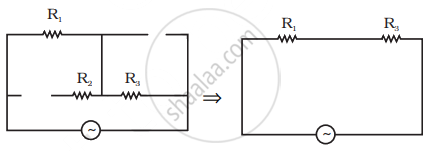
Here the above figure is equivalent circuit to given circuit.
Total impedance,Z = R1 + R3
APPEARS IN
संबंधित प्रश्न
Derive an expression for e.m.f. and current in terms of turns ratio
The primary coil of an ideal step-up transformer has 100 turns and the transformation ratio is also 100. The input voltage and power are 220 V and 1100 W, respectively. Calculate the
(a) number of turns in secondary
(b) current in the primary
(c) a voltage across secondary
(d) current in secondary
(e) power in secondary
Which coil of a step up transformer is made thicker and why?
State the principle of a step-up transformer. Explain, with the help of a labeled diagram, its working ?
State the factors on which the frequency of the alternating e.m.f. depends.
Why is the core of a transformer made of soft iron?
Applying e.m. f to primary coil is 210 V. If the number of turns in primary coil is 200 turns and that of in secondary coil is 20 turns, then find out the output voltage. Name the type of transformer.
An ideal transformer has 100 turns in the primary and 250 turns in the secondary. The peak value of the AC is 28 V. The rms secondary voltage is nearest to ______
Distinguish between Step up and Step Down Transformer.
Explain step up and step down transformer?
What are step-up and step-down transformers?
Find out the phase relationship between voltage and current in a pure inductive circuit.
Magnetic flux Φ in weber in a closed circuit of resistance 10Ω varies with time Φ (sec) as Φ = 6t2 - 5t + 1. The magnitude of induced current at t = 0.25s is ______.
An ideal transformer converts 220 V a.c. to 3.3 kV a.c. to transmit a power of 4.4 kW. If primary coil has 600 turns, then alternating current in secondary coil is ______.
An iron rod of 0.2 cm2 cross-sectional area is subjected to a magnetising field of 1200 Am-1. If the susceptibility of iron is 599, then the magnetic flux produced is ______.
The primary coil of a transformer has 60 turns whereas its secondary coil has 3000 turns.
If a current of 5A flows in the primary coil, how much current will flow in a load in the secondary coil? State the assumption you have made regarding the transformer, in this calculation.
For what purpose are the transformers used?
Which description of the primary coil is correct?
For an ideal transformer with \[\frac{V_s}{V_p}=3\], what is \[\frac{I_p}{I_s}\]?
