मराठी
कर्नाटक बोर्ड पी.यू.सी.पीयूसी विज्ञान 2nd PUC Class 12

If a LC circuit is considered analogous to a harmonically oscillating spring block system, which energy of the LC circuit would be analogous to potential energy and which one analogous - Physics

Advertisements
Advertisements

प्रश्न

If a LC circuit is considered analogous to a harmonically oscillating spring block system, which energy of the LC circuit would be analogous to potential energy and which one analogous to kinetic energy?

टीपा लिहा
Advertisements

उत्तर

When a charged capacitor C having an initial charge q0 is discharged through an inductance L, the charge and current in the circuit starts oscillating simple harmonically. If the resistance of the circuit is zero, no energy is dissipated as heat. We also assume an idealized situation in which energy is not radiated away from the circuit. The total energy associated with the circuit is constant.

The oscillation of the LC circuit is electromagnetic analogous to the mechanical oscillation of a block-spring system.

The total energy of the system remains conserved.

`1/2 CV^2 + 1/2 LI^2` = constant = `1/2 CV_0^2 = 1/2 LI^2`
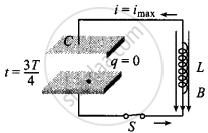

At t = `(3T)/4`, capacitor again discharges completely i = imax
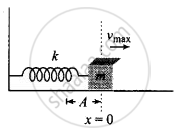

At `t = (T)/2`, block again reaches its mean position and its velocity becomes maximum

Comparison of oscillation of a mass-spring system and an LC circuit

Mass spring system v/s LC circuit
Displacement `(x)`   Charge `(q)`
Velocity `(v)`   Current `(i)`
Acceleration `(a)`   Rate of change of current `((di)/(dt))`
Mass `(m)` [Inertia]   Inductance `(L)` [Inertia of electricity]
Momentum `(p = mv)`   Magnetic flux `(phi = Li)`
Retarding force `(-m (dv)/(dt))`   Self induced emf `(-L (di)/(dt))`


Equation of free oscillations:

`(d^2x)/(dt^2) = - ω^2x`; where ω = `sqrt(K/m)`


Equation of free oscillations:

`(d^2q)/(dt^2) = - (1/(LC)).q`; where ω2 = `1/(LC)`

Force constant K   Capacitance C
Kinetic energy = `1/2 mv^2`   Magnetic energy = `1/2 Li^2`
Elastic potential energy = `1/2 Kx^2`   Electrical potential energy = `1/2 q^2/C`

If we consider an L-C circuit analogous to a harmonically oscillating spring block system. The electrostatic energy `1/2 CV^2` is analogous to potential energy and energy associated with moving charges (current) that is magnetic energy `(1/2 LI^2)` is analogous to kinetic energy.

shaalaa.com
  या प्रश्नात किंवा उत्तरात काही त्रुटी आहे का?
पाठ 7: Alternating Current - MCQ I [पृष्ठ ४३]

APPEARS IN

एनसीईआरटी एक्झांप्लर Physics [English] Class 12
पाठ 7 Alternating Current
MCQ I | Q 7.14 | पृष्ठ ४३

व्हिडिओ ट्यूटोरियलVIEW ALL [3]

संबंधित प्रश्‍न

Discuss the composition of two S.H.M.s along the same path having same period. Find the resultant amplitude and intial phase.


Answer in brief.

What is the natural frequency of the LC circuit? What is the reactance of this circuit at this frequency?


In a series LR circuit XL = R and power factor of the circuit is P1. When capacitor with capacitance C such that XL = XC is put in series, the power factor becomes P2. Calculate P1/P2.


Derive an expression for the impedance of an LCR circuit connected to an AC power supply. Draw phasor diagram.


A 10 μF capacitor is charged to a 25 volt of potential. The battery is disconnected and a pure 100 m H coil is connected across the capacitor so that LC oscillations are set up. Calculate the maximum current in the coil.


Answer in brief.

The total impedance of a circuit decreases when a capacitor is added in series with L and R. Explain why?


Calculate the value of the capacity in picofarad, which will make 101.4 microhenry inductance to oscillate with a frequency of one megahertz.


The oscillation in L.C. circuit is produced due to ____________.


Electrical oscillations of desired frequency can be obtained by ______.


The magnetic field energy in an inductor changes from maximum value to minimum value in 10 ms, when connected to an a.c. source. The frequency of the source is ______.


A radio can tune over the frequency range of a portion of MW broadcast band: (800 kHz to 1200 kHz). If its LC circuit has an effective inductance of 200 µH, what must be the range of its variable capacitor?

[Hint: For tuning, the natural frequency i.e., the frequency of free oscillations of the LC circuit should be equal to the frequency of the radio wave.]


An LC circuit contains a 20 mH inductor and a 50 µF capacitor with an initial charge of 10 mC. The resistance of the circuit is negligible. Let the instant the circuit is closed be t = 0.

(a) What is the total energy stored initially? Is it conserved during LC oscillations?

(b) What is the natural frequency of the circuit?

(c) At what time is the energy stored
(i) completely electrical (i.e., stored in the capacitor)?
(ii) completely magnetic (i.e., stored in the inductor)?

(d) At what times is the total energy shared equally between the inductor and the capacitor?

(e) If a resistor is inserted in the circuit, how much energy is eventually dissipated as heat?


The natural frequency (ca0) of oscillations in LC circuit is given by ______.


When an oscillator completes 100 oscillations its amplitude reduces to `1/3` of its initial value. What will be its amplitude, when it completes 200 oscillations?


In an oscillating system, a restoring force is a must. In an LC circuit restoring force is provided by ______.


Share
Notifications

Englishहिंदीमराठी


      Forgot password?
Use app×