Advertisements
Advertisements
प्रश्न
What are step-up and step-down transformers?
Advertisements
उत्तर
- A transformer that increases the voltage by decreasing current is known as a step-up transformer.
- A transformer that decreases the voltage by increasing the current is a step-down transformer.
APPEARS IN
संबंधित प्रश्न
Which coil of a step up transformer is made thicker and why?
The teachers of Geeta’s school took the students on a study trip to a power generating station, located nearly 200 km away from the city. The teacher explained that electrical energy is transmitted over such a long distance to their city, in the form of alternating current (ac) raised to a high voltage. At the receiving end in the city, the voltage is reduced to operate the devices. As a result, the power loss is reduced. Geeta listened to the teacher and asked questions about how the ac is converted to a higher or lower voltage.
1) Name the device used to change the alternating voltage to a higher or lower value. State one cause for power dissipation in this device.
2) Explain with an example, how power loss is reduced if the energy is transmitted over long distances as an alternating current rather than a direct current.
3) Write two values each shown by the teachers and Geeta.
The following diagram in Fig. 10.44 shows a coil X connected to a sensitive centre –zero galvanometer G and a coil P connected to a battery through a switch S.
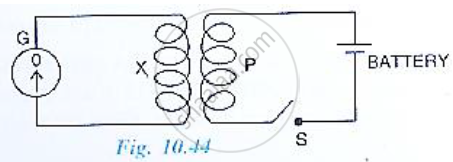
(a) Describe the observation when the switch S is (i) closed suddenly, (ii) then kept closed, (iii) finally opened.
(b) Name and state the law which explains the above observations.
The primary of a transformer has 40 turns and works on 100 V and 100 W. Find a number of turns in the secondary to step up the voltage to 400 V. Also calculate the current in the secondary and primary.
Which among the following, is not a cause for power loss in a transformer?
The line that draws power supply to your house from street has ______.
- zero average current.
- 220 V average voltage.
- voltage and current out of phase by 90°.
- voltage and current possibly differing in phase `phi` such that `|phi| < pi/2`.
Draw the effective equivalent circuit of the circuit shown in figure, at very high frequencies and find the effective impedance.

A step down transformer connected to an AC mains supply of 220 V is made to operate at 11 V, 44 W lamp. Ignoring power losses in the transformer, what is the current in the primary circuit?
