Advertisements
Advertisements
प्रश्न
A transformer converts 240 V AC to 60 V AC. The secondary has 75 turns. The number of turns in primary are _______.
(A) 600
(B) 500
(C) 400
(D) 300
Advertisements
उत्तर
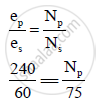
∴ `N_p` = 300
APPEARS IN
संबंधित प्रश्न
Derive an expression for ratio of e.m.f.s and currents in terms of number of turns in primary and secondary coil.
A power transmission line feeds input power at 2200 V to a step-down transformer with its primary windings having 300 turns. Find the number of turns in the secondary to get the power output at 220 V.
Find the ratio of primary and secondary currents in terms of turn ratio in an ideal transformer.
State the principle of transformer working with the help of a diagram
Which coil of a step up transformer is made thicker and why?
Name two factors on which the magnitude of an induced e.m.f. in the secondary coil depends.
The teachers of Geeta’s school took the students on a study trip to a power generating station, located nearly 200 km away from the city. The teacher explained that electrical energy is transmitted over such a long distance to their city, in the form of alternating current (ac) raised to a high voltage. At the receiving end in the city, the voltage is reduced to operate the devices. As a result, the power loss is reduced. Geeta listened to the teacher and asked questions about how the ac is converted to a higher or lower voltage.
1) Name the device used to change the alternating voltage to a higher or lower value. State one cause for power dissipation in this device.
2) Explain with an example, how power loss is reduced if the energy is transmitted over long distances as an alternating current rather than a direct current.
3) Write two values each shown by the teachers and Geeta.
Complete the following sentence :
……… energy is converted into …………energy by an electric motor.
State two factors on which the magnitude of induced e.m.f. depend.
Name the phenomenon ?
What is the function of a transformer in an a.c. circuit? How do the input and output powers in a transformer compare?
Name two kind of energy loss in a transformer. How is it minimized?
The primary coil of a transformed has 800 urns and the secondary coil has 8 turns. It is connected to a 220 V a.c. supply. What will be the output voltage?
The input and output voltage of a transformer are 220 V and 44 V respectively. Find: the turns ratio.
Given the input current 15 A and the input voltage of 100 V for a step-up transformer having 90% efficiency, find the output power and the voltage in the secondary if the output current is 3 A.
State the principle of a step-up transformer. Explain, with the help of a labeled diagram, its working ?
State the principle of working of a transformer. Can a transformer be used to step up or step down a d.c. voltage? Justify your answer.
A transformer is used to step up an alternating emf of 200V to 440V. If the primary coil has 1000 turns, calculate the number of turns in the secondary coil.
An a.c generator generates an emf 'ε' where ε = 314 Sin (50πt) volt. Calculate the frequency of emf ε.
What is the ideal transformer?
A transformer lowers e.m.f. from 220 V to 15 V. If the number of turns in primary are 3520, how many turns are in the secondary coil?
The primary and secondary coils of a transformer each have an inductance of 200 x 10-6 H. The mutual inductance between the windings is 4 x 10⁻⁶ H. What percentage of the flux from one coil reaches the other?
State the mathematical relation between a number of turns in the primary coil to a secondary coil in the step-up transformer.
Distinguish between Step up and Step Down Transformer.
Describe the construction and working of a transformer with a neat labelled diagram.
Transformer works on ______.
In a transformer, the number of turns in the primary and the secondary are 410 and 1230 respectively. If the current in primary is 6A, then that in the secondary coil is
Explain the construction of transformer.
Give the advantage of AC in long distance power transmission with an illustration.
Find out the phase relationship between voltage and current in a pure inductive circuit.
The 300 turn primary of a transformer has resistance 0.82 Ω and the resistance of its secondary of 1200 turns is 6.2 Ω. Find the voltage across the primary if the power output from the secondary at 1600V is 32 kW. Calculate the power losses in both coils when the transformer efficiency is 80%
A 100% efficient transformer has 100 turns in the primary and 50 turns in its secondary coil. If the current in the secondary coil is 6 A, then the current in the primary coil is ______.
A power transmission line feeds input power at 2300 V to a stepdown transformer with its primary windings having 4000 turns. What should be the number of turns in the secondary in order to get output power at 230 V?
Read the following paragraph and answer the question:

Long distance power transmissions
The large-scale transmission and distribution of electrical energy over long distances is done with the use of transformers. The voltage output of the generator is stepped up. It is then transmitted over long distances to an area sub-station near the consumers. There the voltage is stepped down. It is further stepped down at distributing sub-stations and utility poles before a power supply of 240 V reaches our homes.
Which of the following statement is true?
Read the following paragraph and answer the question:
Long distance power transmissions
The large-scale transmission and distribution of electrical energy over long distances is done with the use of transformers. The voltage output of the generator is stepped up. It is then transmitted over long distances to an area sub-station near the consumers. There the voltage is stepped down. It is further stepped down at distributing sub-stations and utility poles before a power supply of 240 V reaches our homes.
If the secondary coil has a greater number of turns than the primary, ______.
A transformer is essentially an a.c. device. It cannot work on d.c. It changes alternating voltages or currents. It does not affect the frequency of a.c. It is based on the phenomenon of mutual induction. A transformer essentially consists of two coils of insulated copper wire having different numbers of turns and wound on the same soft iron core.
The number of turns in the primary and secondary coils of an ideal transformer is 2000 and 50 respectively. The primary coil is connected to a main supply of 120 V and secondary coil is connected to a bulb of resistance 0.6 Ω.
The value of current in the bulb is ______.
A transformer is essentially an a.c. device. It cannot work on d.c. It changes alternating voltages or currents. It does not affect the frequency of a.c. It is based on the phenomenon of mutual induction. A transformer essentially consists of two coils of insulated copper wire having different numbers of turns and wound on the same soft iron core.
The number of turns in the primary and secondary coils of an ideal transformer is 2000 and 50 respectively. The primary coil is connected to a main supply of 120 V and secondary coil is connected to a bulb of resistance 0.6 Ω.
Power in primary coil is ______.
Name one electrical device which works on Faraday's law of electromagnetic induction principle.
Electrical energy is transmitted over large distances at high alternating voltages. Which of the following statements is (are) correct?
- For a given power level, there is a lower current.
- Lower current implies less power loss.
- Transmission lines can be made thinner.
- It is easy to reduce the voltage at the receiving end using step-down transformers.
In a transformer, number of turns in the primary coil are 140 and that in the secondary coil are 280. If current in primary coil is 4 A, then that in the secondary coil is ______.
An ideal transformer converts 220 V a.c. to 3.3 kV a.c. to transmit a power of 4.4 kW. If primary coil has 600 turns, then alternating current in secondary coil is ______.
An iron rod of 0.2 cm2 cross-sectional area is subjected to a magnetising field of 1200 Am-1. If the susceptibility of iron is 599, then the magnetic flux produced is ______.
Derive the equation for a transformer.
How do the input and output powers in a transformer compare? State the assumption made.
A step down transformer connected to an AC mains supply of 220 V is made to operate at 11 V, 44 W lamp. Ignoring power losses in the transformer, what is the current in the primary circuit?
An ideal transformer converts 170 V a.c. to 1.70 KV a.c. to transmit a power of 3.4 KW. If primary coil has 500 turns then alternating current in secondary coil is ______.
On which principle is a transformer based?
What does the primary coil draw from the source?
Which law relates the changing flux to the EMF induced in both coils?
What is the induced EMF in the secondary coil?
