Advertisements
Advertisements
प्रश्न
What is a transformer?
Advertisements
उत्तर
A transformer is an electrical device that converts low alternating voltage at high current into high alternating voltage at low current and vice versa. It works on the principle of mutual inductance.
APPEARS IN
संबंधित प्रश्न
Derive an expression for ratio of e.m.f.s and currents in terms of number of turns in primary and secondary coil.
A transformer converts 240 V AC to 60 V AC. The secondary has 75 turns. The number of turns in primary are _______.
(A) 600
(B) 500
(C) 400
(D) 300
Find the ratio of primary and secondary currents in terms of turn ratio in an ideal transformer.
State the principle of transformer working with the help of a diagram
Which coil of a step up transformer is made thicker and why?
You are required to make an electromagnet from a soft iron bar by using a cell, an insulated coil of copper wire and a switch. (a) Draw a circuit diagram to represent the process. (b) label the poles of the electromagnet.
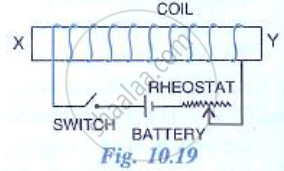
The adjacent diagram shows a coil would around a soft iron bar XY. (a) State the polarity at the end X and Y as the switch is pressed. (b) Suggest one way increasing the strength of electromagnet so formed.
Complete the following sentence :
……… energy is converted into …………energy by an electric motor.
The following diagram in Fig.10.42 shows a coil of several turns of copper wire connected to a sensitive centre zero galvanometer G near a magnet NS. The coil is free to move in the direction shown in the diagram.
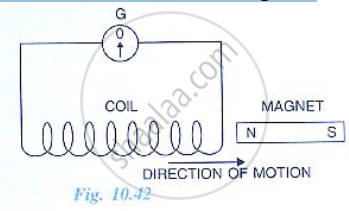
(i) Describe the observation if the coil is rapidly moved.
(ii) How would the observation be altered if (a) the coil has twice as many turns (b the coil was made to move three times as fast?
How are the e.m.f in the primary and secondary coils of a transformer related with the number of turns in these coils?
Why is the iron core of a transformer made laminated (thin sheets) instead of being in one solid piece?
The transformer is used in ______ current circuits.
In a transformer, the frequency of A.C. voltage ______.
What is the function of a transformer in an a.c. circuit? How do the input and output powers in a transformer compare?
The primary coil of a transformed has 800 urns and the secondary coil has 8 turns. It is connected to a 220 V a.c. supply. What will be the output voltage?
A transformer is designed to work from a 240 V a.c. mains and to give a supply of 8 V to ring a house bell. The primary coil has 4800 turns. How many turns will be in the secondary coil?
State the principle of working of a transformer. Can a transformer be used to step up or step down a d.c. voltage? Justify your answer.
In an ideal transformer, an output of 66 kV is required when an input voltage of 220 V is available. If the primary has 300 turns, how many turns should the secondary have?
State the factors on which the frequency of the alternating e.m.f. depends.
Copy the given diagram of a transformer and complete it. Name the parts A and B. Name the part you have drawn to complete the diagram. What is the material of this part? Is this transformer a step-up or step-down? Give reason.
The primary coil of a transformer has 200 turns while the secondary coil has 1000 turns. What type of transformer is this? if the input voltage is 10V, what will be the output voltage?
A circular coil of 100 turns with a cross-sectional area of 1 m2 is kept with its plane perpendicular to the magnetic field of 1 T. The magnetic flux linkage is ______.
An ideal transformer has 100 turns in the primary and 250 turns in the secondary. The peak value of the AC is 28 V. The rms secondary voltage is nearest to ______
The primary of a transformer has 40 turns and works on 100 V and 100 W. Find a number of turns in the secondary to step up the voltage to 400 V. Also calculate the current in the secondary and primary.
State whether true or false. If false, correct the statement.
A transformer can step up direct current.
A 200V/120V step-down transformer of 90% efficiency is connected to an induction stove of resistance 40 Ω. Find the current drawn by the primary of the transformer.
The output power in step-up transformer used in practice is ______.
A 220 V input is supplied to a transformer. The output circuit draws a current of 2.0 A at 440 V. If the ratio of output to input power is 0.8, then the current drawn by primary winding is ______.
A transformer is essentially an a.c. device. It cannot work on d.c. It changes alternating voltages or currents. It does not affect the frequency of a.c. It is based on the phenomenon of mutual induction. A transformer essentially consists of two coils of insulated copper wire having different numbers of turns and wound on the same soft iron core.
The number of turns in the primary and secondary coils of an ideal transformer is 2000 and 50 respectively. The primary coil is connected to a main supply of 120 V and secondary coil is connected to a bulb of resistance 0.6 Ω.
The value of voltage across the secondary coil is ______.
A transformer is essentially an a.c. device. It cannot work on d.c. It changes alternating voltages or currents. It does not affect the frequency of a.c. It is based on the phenomenon of mutual induction. A transformer essentially consists of two coils of insulated copper wire having different numbers of turns and wound on the same soft iron core.
The number of turns in the primary and secondary coils of an ideal transformer is 2000 and 50 respectively. The primary coil is connected to a main supply of 120 V and secondary coil is connected to a bulb of resistance 0.6 Ω.
The value of current in the bulb is ______.
A transformer is essentially an a.c. device. It cannot work on d.c. It changes alternating voltages or currents. It does not affect the frequency of a.c. It is based on the phenomenon of mutual induction. A transformer essentially consists of two coils of insulated copper wire having different numbers of turns and wound on the same soft iron core.
The number of turns in the primary and secondary coils of an ideal transformer is 2000 and 50 respectively. The primary coil is connected to a main supply of 120 V and secondary coil is connected to a bulb of resistance 0.6 Ω.
Power in primary coil is ______.
The primary coil of a transformer has 800 turns and the secondary coil has 8 turns. It is connected to a 220 V ac supply. What will be the output voltage?
The primary winding of a transformer has 100 turns and its secondary winding has 200 turns. The primary is connected to an a.c supply of 120 V and the current flowing in its is 10 A. The voltage and the current in the secondary are ______.
Electrical energy is transmitted over large distances at high alternating voltages. Which of the following statements is (are) correct?
- For a given power level, there is a lower current.
- Lower current implies less power loss.
- Transmission lines can be made thinner.
- It is easy to reduce the voltage at the receiving end using step-down transformers.
For an LCR circuit, the power transferred from the driving source to the driven oscillator is P = I2Z cos φ.
- Here, the power factor cos φ ≥ 0, P ≥ 0.
- The driving force can give no energy to the oscillator (P = 0) in some cases.
- The driving force cannot syphon out (P < 0) the energy out of oscillator.
- The driving force can take away energy out of the oscillator.
Draw the effective equivalent circuit of the circuit shown in figure, at very high frequencies and find the effective impedance.

A transformer operating at primary voltage 8 kV and secondary voltage 160 V serves a load of 80 kW. Assuming the transformer to be ideal with purely resistive load and working on unity power factor, the loads in the primary and secondary circuit would be:
In a transformer, number of turns in the primary coil are 140 and that in the secondary coil are 280. If current in primary coil is 4 A, then that in the secondary coil is ______.
The magnetic flux through a coil perpendicular to its plane is varying according to the relation Φ = (5t3 + 4t2 + 2t - 5) Weber. If the resistant of the coil is 5 ohm, then the induced current through the coil at t = 2 sec will be ______.
The primary coil having NP turns of an ideal transformer is supplied with an alternating voltage VP. Obtain an expression for the voltage VS induced in its secondary coil having NS turns.
Efficiency of transformer is the ratio of ______.
The primary coil of a transformer has 60 turns whereas its secondary coil has 3000 turns.
If a current of 5A flows in the primary coil, how much current will flow in a load in the secondary coil? State the assumption you have made regarding the transformer, in this calculation.
Explain why core of a transformer is always laminated.
A 12 V, 60 W lamp is connected to 220 V AC via an ideal transformer. Find the primary current.
Which loss is reduced by laminations in the core?
Which winding is the output coil connected to the load?
What is the induced EMF in the secondary coil?
