Advertisements
Advertisements
प्रश्न
State the underlying principle of a transformer. How is the large scale transmission of electric energy over long distances done with the use of transformers?
Advertisements
उत्तर
Transformer Principle: It is a device which converts high voltage AC into low voltage AC and vice-versa. It is based upon the principle of mutual induction. When alternating current is passed through a coil, an induced emf is set up in the neighbouring coil.
Transformers are used for transmission of electrical energy over long distances.
It step up the output voltage of power plant using step up transformer which reduce the current through cables and hence reduce resistive power loss. Then a step down transformer is used at consumer end to step down the voltage.
संबंधित प्रश्न
Explain why an induced current must flow in such a direction so as to oppose the change producing it.
The following diagram in Fig.10.42 shows a coil of several turns of copper wire connected to a sensitive centre zero galvanometer G near a magnet NS. The coil is free to move in the direction shown in the diagram.
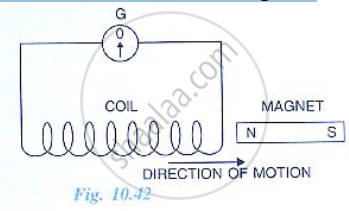
(i) Describe the observation if the coil is rapidly moved.
(ii) How would the observation be altered if (a) the coil has twice as many turns (b the coil was made to move three times as fast?
What is the ideal transformer?
The output power in step-up transformer used in practice is ______.
A transformer is essentially an a.c. device. It cannot work on d.c. It changes alternating voltages or currents. It does not affect the frequency of a.c. It is based on the phenomenon of mutual induction. A transformer essentially consists of two coils of insulated copper wire having different numbers of turns and wound on the same soft iron core.
The number of turns in the primary and secondary coils of an ideal transformer is 2000 and 50 respectively. The primary coil is connected to a main supply of 120 V and secondary coil is connected to a bulb of resistance 0.6 Ω.
The value of current in primary coil is ______.
A 60 W load is connected to the secondary of a transformer whose primary draws line voltage. If a current of 0.54 A flows in the load, what is the current in the primary coil? Comment on the type of transformer being used.
A transformer operating at primary voltage 8 kV and secondary voltage 160 V serves a load of 80 kW. Assuming the transformer to be ideal with purely resistive load and working on unity power factor, the loads in the primary and secondary circuit would be:
Derive the equation for a transformer.
In an ideal transformer, the turns ratio is `N_p/N_s = 1/2`. The ratio Vs : Vp is equal to (the symbols carry their usual meaning):
Why is soft iron used in the core?
