Advertisements
Advertisements
प्रश्न
State the underlying principle of a transformer. How is the large scale transmission of electric energy over long distances done with the use of transformers?
Advertisements
उत्तर
Transformer Principle: It is a device which converts high voltage AC into low voltage AC and vice-versa. It is based upon the principle of mutual induction. When alternating current is passed through a coil, an induced emf is set up in the neighbouring coil.
Transformers are used for transmission of electrical energy over long distances.
It step up the output voltage of power plant using step up transformer which reduce the current through cables and hence reduce resistive power loss. Then a step down transformer is used at consumer end to step down the voltage.
संबंधित प्रश्न
The following diagram in Fig. 10.44 shows a coil X connected to a sensitive centre –zero galvanometer G and a coil P connected to a battery through a switch S.
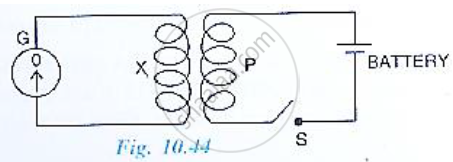
(a) Describe the observation when the switch S is (i) closed suddenly, (ii) then kept closed, (iii) finally opened.
(b) Name and state the law which explains the above observations.
Describe, with the help of a suitable diagram, the working principle of a step-up transformer. Obtain the relation between input and output voltages in terms of the number of turns of primary and secondary windings and the currents in the input and output circuits.
A transformer lowers e.m.f. 220 V to 12 volts. If the number of turns in primary are 8800, how many turns are in secondary coil?
A step-down transformer connected to the main supply of 220 V is used to operate 11V,88W lamp. Calculate
- Voltage transformation ratio and
- Current in the primary
A transformer is used ______
What does the primary coil draw from the source?
Which winding is the output coil connected to the load?
What does the secondary coil deliver to the circuit?
What is the induced EMF in the primary coil?
