Advertisements
Advertisements
प्रश्न
An electric dipole is held in a uniform electric field.
(i) Show that the net force acting on it is zero.
(ii) The dipole is aligned parallel to the field. Find the work done in rotating it through the angle of 180°.
Advertisements
उत्तर
(i) Consider an electric dipole consisting of two equal and opposite point charges, −q at A and + q at B, separated by a small distance 2a.
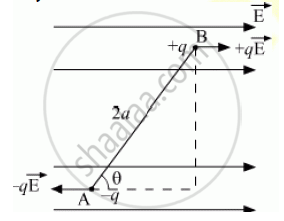
AB = 2a, having dipole moment
`|vecP| = q(2a)`
Let this dipole be held in a uniform external electric field `vecE`at an angle θ with the direction of `vecE`
Force on charge −q at A= − q ,`vecE` in a direction opposite to `vecE`
Force on charge +q at B = +q ,`vecE` along the direction of `vecE`
Net force on the dipole = qE − qE = 0
(ii) Work done on dipole, W = ΔU = pE (cos θ1 − cos θ2)
W = pE (cos0° − cos180°)
W = 2pE
संबंधित प्रश्न
Two charges 5 × 10⁻⁸ C and −3 × 10⁻⁸ C are located 16 cm apart. At what point(s) on the line joining the two charges is the electric potential zero? Take the potential at infinity to be zero.
Derive an expression for the electric potential at any point along the axial line of an electric dipole.
The electric potential at a point on the equatorial line of an electric dipole is ______.
A hollow metal sphere of radius 5 cm is charged such that the potential on its surface is 10 V. The potential at a distance of 2 cm from the centre of the sphere is ______.
A point P lies at a distance x from the midpoint of an electric dipole on its axis. The electric potential at point P is proportional to ______.
An electric dipole consists of two equal and opposite charges, +q and −q, separated by a small distance 2a. What is the magnitude of its dipole moment and in which direction is it directed?
For \[r \gg a\], applying the Binomial theorem to \[r_1^2 \approx r^2\left(1 - \frac{2a\cos\theta}{r}\right)\] and retaining only first-order terms, the approximation for \[\frac{1}{r_1}\] is:
The electrostatic potential at a general point at distance r from the center of a dipole, making an angle θ with the dipole axis (for r >> a), is:
At an axial point of an electric dipole (θ = 0° or 180°), the potential is:
The exact potential on the axial line of a dipole with half-length l, before applying the approximation \[r \gg l\], is:
