Advertisements
Advertisements
प्रश्न
Two charges 5 × 10⁻⁸ C and −3 × 10⁻⁸ C are located 16 cm apart. At what point(s) on the line joining the two charges is the electric potential zero? Take the potential at infinity to be zero.
Advertisements
उत्तर
Given: q1 = 5 × 10⁻⁸ C
q2 = −3 × 10⁻⁸ C
r = 16 cm
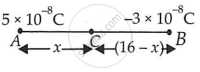
Let C be the point on the line joining the two charges, where the electric potential is zero, then
VC = 0
VCA + VCB = 0
VCA = −VCB
`1/(4piε_0) q_A/r_(CA) = -1/(4piε_0) q_B/r_(CB)`
`(5 xx 10^-8 C)/(x xx 10^-2 m) = (-(-3 xx 10^-8 C))/([(16 - x) xx 10^-2 m])`
`5/x = 3/(16 -x)`
5(16 − x) = 3x
80 − 5x = 3x
8x = 80 m
∴ `x = 80/8`
= 10 cm
So, the electric potential is zero at a distance of 10 cm from the charge 5 × 10⁻⁸ C on the line joining the two charges, between them.
If point C is not between the two charges, then
VCA + VCB = 0
VCA = −VCB
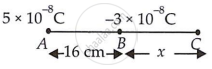
`1/(4piε_0) q_A/r_(CA) = -1/(4piε_0) q_B/r_(CB)`
`(5 xx 10^-8 C)/([(16 + x) xx 10^-2 m]) = (-(-3 xx 10^-8 C))/(x xx 10^-2 m)`
`5/(16 + x) = 3/x`
5x = 48 + 3x
2x = 48 m
= 24 cm
So, the electric potential is also zero at a distance of 24 cm from the charge −3 × 10⁻⁸ C, i.e., at a distance of (24 + 16) = 40 cm from the charge 5 × 10⁻⁸ C on the side of the charge −3 × 10⁻⁸ C.
संबंधित प्रश्न
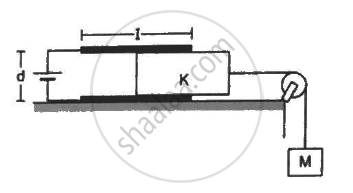
Consider the situation shown in figure (31-E29). The width of each plate is b. The capacitor plates are rigidly clamped in the laboratory and connected to a battery of emf ε. All surfaces are frictionless. Calculate the value of M for which the dielectric slab will stay in equilibrium.
Derive an expression for the electric potential at any point along the axial line of an electric dipole.
A hollow metal sphere of radius 5 cm is charged such that the potential on its surface is 10 V. The potential at a distance of 2 cm from the centre of the sphere is ______.
An electric field of 1000 V/m is applied to an electric dipole at angle of 45°. The value of electric dipole moment is 10-29 C.m. What is the potential energy of the electric dipole?
A point P lies at a distance x from the midpoint of an electric dipole on its axis. The electric potential at point P is proportional to ______.
Assertion (A): The potential (V) at any axial point, at 2 m distance (r) from the centre of the dipole of dipole moment vector `vec P` of magnitude, 4 × 10⁻⁶ cm, is ±9 × 10³ V.
(Take `1/(4 pi epsilon_0)` = 9 × 10⁹ SI units)
Reason (R): V = `+- (2 vec P)/(4 pi epsilon_0 r^2)`, where r is the distance of any axial point, situated at 2 m from the centre of the dipole.
In the light of the above statements, choose the correct answer from the options given below:
Assertion A: The potential (V) at any axial point, at 2 m distance (r) from the centre of the dipole of dipole moment vector of magnitude, 4 × 10⁻⁶ Cm, is ± 9 × 10³ V. (Take = 9 × 10⁹ SI units)
Reason R: where r is the distance of any axial point, situated at 2 m from the centre of the dipole.
In the light of the above statements, choose the correct answer from the options given below:
An electric dipole consists of two equal and opposite charges, +q and −q, separated by a small distance 2a. What is the magnitude of its dipole moment and in which direction is it directed?
The electrostatic potential at a general point at distance r from the center of a dipole, making an angle θ with the dipole axis (for r >> a), is:
Since \[p\cos\theta = \vec{p} \cdot \hat{r}\], the dipole potential at a point (r >> a) written in compact vector form is:
At large distances, the potential of an electric dipole falls off as:
The exact potential on the axial line of a dipole with half-length l, before applying the approximation \[r \gg l\], is:
In the general formula for the potential due to a dipole, setting θ = 0° and θ = 90° respectively recovers which two special cases?
A water molecule (H₂O) behaves like a natural electric dipole because:
At an axial point located on the side of the negative charge (θ = 180°), the potential due to the dipole is:
In the binomial-approximation derivation of the dipole potential, which order of terms in \[a/r\] is retained throughout the calculation?
Using the exact general-point formula \[V = \frac{1}{4\pi\varepsilon_0}\frac{p\cos\theta}{r^2 - l^2\cos^2\theta}\], the potential on the equatorial line (θ = 90°) is zero:
