Advertisements
Advertisements
प्रश्न
Two charges 5 × 10⁻⁸ C and −3 × 10⁻⁸ C are located 16 cm apart. At what point(s) on the line joining the two charges is the electric potential zero? Take the potential at infinity to be zero.
Advertisements
उत्तर
Given: q1 = 5 × 10⁻⁸ C
q2 = −3 × 10⁻⁸ C
r = 16 cm
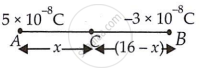
Let C be the point on the line joining the two charges, where the electric potential is zero, then
VC = 0
VCA + VCB = 0
VCA = −VCB
`1/(4piε_0) q_A/r_(CA) = -1/(4piε_0) q_B/r_(CB)`
`(5 xx 10^-8 C)/(x xx 10^-2 m) = (-(-3 xx 10^-8 C))/([(16 - x) xx 10^-2 m])`
`5/x = 3/(16 -x)`
5(16 − x) = 3x
80 − 5x = 3x
8x = 80 m
∴ `x = 80/8`
= 10 cm
So, the electric potential is zero at a distance of 10 cm from the charge 5 × 10⁻⁸ C on the line joining the two charges, between them.
If point C is not between the two charges, then
VCA + VCB = 0
VCA = −VCB
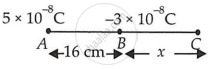
`1/(4piε_0) q_A/r_(CA) = -1/(4piε_0) q_B/r_(CB)`
`(5 xx 10^-8 C)/([(16 + x) xx 10^-2 m]) = (-(-3 xx 10^-8 C))/(x xx 10^-2 m)`
`5/(16 + x) = 3/x`
5x = 48 + 3x
2x = 48 m
= 24 cm
So, the electric potential is also zero at a distance of 24 cm from the charge −3 × 10⁻⁸ C, i.e., at a distance of (24 + 16) = 40 cm from the charge 5 × 10⁻⁸ C on the side of the charge −3 × 10⁻⁸ C.
संबंधित प्रश्न
An electric dipole is held in a uniform electric field.
(i) Show that the net force acting on it is zero.
(ii) The dipole is aligned parallel to the field. Find the work done in rotating it through the angle of 180°.
Derive an expression for the electric potential at any point along the axial line of an electric dipole.
The electric potential at a point on the equatorial line of an electric dipole is ______.
Assertion A: The potential (V) at any axial point, at 2 m distance (r) from the centre of the dipole of dipole moment vector of magnitude, 4 × 10⁻⁶ Cm, is ± 9 × 10³ V. (Take = 9 × 10⁹ SI units)
Reason R: where r is the distance of any axial point, situated at 2 m from the centre of the dipole.
In the light of the above statements, choose the correct answer from the options given below:
An electric dipole consists of two equal and opposite charges, +q and −q, separated by a small distance 2a. What is the magnitude of its dipole moment and in which direction is it directed?
The electrostatic potential at a general point at distance r from the center of a dipole, making an angle θ with the dipole axis (for r >> a), is:
Since \[p\cos\theta = \vec{p} \cdot \hat{r}\], the dipole potential at a point (r >> a) written in compact vector form is:
At an axial point of an electric dipole (θ = 0° or 180°), the potential is:
The electric potential at any point on the equatorial line of a dipole (θ = 90°) is:
The exact potential on the axial line of a dipole with half-length l, before applying the approximation \[r \gg l\], is:
The exact potential at a general point of a dipole with half-length l, before neglecting the \[l^2\cos^2\theta\] term, is:
In the general formula for the potential due to a dipole, setting θ = 0° and θ = 90° respectively recovers which two special cases?
For a dipole with \[p = 3 \times 10^{-10}\ \text{C}\cdot\text{m}\], \[l = 0.05\ \text{m}\], evaluated at an axial point \[r = 0.2\ \text{m}\] using \[k = 9 \times 10^9\ \text{N}\cdot\text{m}^2/\text{C}^2\] in the formula \[V = \frac{kp}{r^2 - l^2}\], the potential is:
A water molecule (H₂O) behaves like a natural electric dipole because:
At an axial point located on the side of the negative charge (θ = 180°), the potential due to the dipole is:
