Advertisements
Advertisements
प्रश्न
Derive an expression for the electric potential at any point along the axial line of an electric dipole.
Advertisements
उत्तर
Suppose P is a point on the axial position of the dipole.
Length of dipole = 2a
Suppose point P is at the distance 'r' from the center of the dipole.
The potential at a point is V = `1/(4piε_0).Q/r`
So, the potential at P due to q is Vq = `1/(4piε_0).q/(a+r)`
Potential at P due to -q is V-q = `1/(4piε_0).(-q)/(a-r)`
The total potential at P is `V = V_q + V_(-q)`
= `1/(4piε_0).q/((a + r)) + 1/(4piε_0).(-q)/((r - a))`
= `q/(4piε_0)[1/((a + r)) + 1/((a - r))]`
V = `q/(4piε_0).(2a)/((a^2 - r^2))`
APPEARS IN
संबंधित प्रश्न
Two charges 5 × 10⁻⁸ C and −3 × 10⁻⁸ C are located 16 cm apart. At what point(s) on the line joining the two charges is the electric potential zero? Take the potential at infinity to be zero.
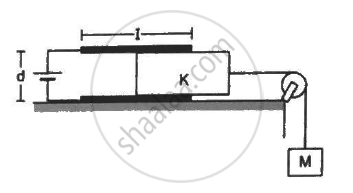
Consider the situation shown in figure (31-E29). The width of each plate is b. The capacitor plates are rigidly clamped in the laboratory and connected to a battery of emf ε. All surfaces are frictionless. Calculate the value of M for which the dielectric slab will stay in equilibrium.
The electric potential at a point on the equatorial line of an electric dipole is ______.
An electric field of 1000 V/m is applied to an electric dipole at angle of 45°. The value of electric dipole moment is 10-29 C.m. What is the potential energy of the electric dipole?
The electric potential at any point on the equatorial line of a dipole (θ = 90°) is:
At large distances, the potential of an electric dipole falls off as:
The exact potential on the axial line of a dipole with half-length l, before applying the approximation \[r \gg l\], is:
The exact potential at a general point of a dipole with half-length l, before neglecting the \[l^2\cos^2\theta\] term, is:
For a dipole with \[p = 3 \times 10^{-10}\ \text{C}\cdot\text{m}\], \[l = 0.05\ \text{m}\], evaluated at an axial point \[r = 0.2\ \text{m}\] using \[k = 9 \times 10^9\ \text{N}\cdot\text{m}^2/\text{C}^2\] in the formula \[V = \frac{kp}{r^2 - l^2}\], the potential is:
At an axial point located on the side of the negative charge (θ = 180°), the potential due to the dipole is:
