Advertisements
Advertisements
प्रश्न
A point P lies at a distance x from the midpoint of an electric dipole on its axis. The electric potential at point P is proportional to ______.
विकल्प
`1/x^2`
`1/x^3`
`1/x^4`
`1/x^{1"/"2}`
Advertisements
उत्तर
A point P lies at a distance x from the midpoint of an electric dipole on its axis. The electric potential at point P is proportional to `underlinebb(1/x^2)`.
Explanation:
The electric potential of the dipole is given by:
V = `(pcostheta)/(4piε_0r^2)`,
where r is the position vector with respect to the midpoint of the dipole and θ is the angle between r and p (dipole moment). Therefore, the electric potential at a point that lies at a distance x from the midpoint of the dipole will be proportional to `1/r^2`.
APPEARS IN
संबंधित प्रश्न
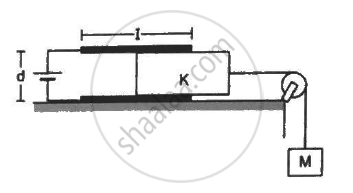
Consider the situation shown in figure (31-E29). The width of each plate is b. The capacitor plates are rigidly clamped in the laboratory and connected to a battery of emf ε. All surfaces are frictionless. Calculate the value of M for which the dielectric slab will stay in equilibrium.
The electric potential at a point on the equatorial line of an electric dipole is ______.
A hollow metal sphere of radius 5 cm is charged such that the potential on its surface is 10 V. The potential at a distance of 2 cm from the centre of the sphere is ______.
The electric potential at any point on the equatorial line of a dipole (θ = 90°) is:
At large distances, the potential of an electric dipole falls off as:
The exact potential on the axial line of a dipole with half-length l, before applying the approximation \[r \gg l\], is:
The exact potential at a general point of a dipole with half-length l, before neglecting the \[l^2\cos^2\theta\] term, is:
For a dipole with \[p = 3 \times 10^{-10}\ \text{C}\cdot\text{m}\], \[l = 0.05\ \text{m}\], evaluated at an axial point \[r = 0.2\ \text{m}\] using \[k = 9 \times 10^9\ \text{N}\cdot\text{m}^2/\text{C}^2\] in the formula \[V = \frac{kp}{r^2 - l^2}\], the potential is:
A water molecule (H₂O) behaves like a natural electric dipole because:
Using the exact general-point formula \[V = \frac{1}{4\pi\varepsilon_0}\frac{p\cos\theta}{r^2 - l^2\cos^2\theta}\], the potential on the equatorial line (θ = 90°) is zero:
