Advertisements
Advertisements
प्रश्न
Derive an expression for ratio of e.m.f.s and currents in terms of number of turns in primary and secondary coil.
Advertisements
उत्तर
Derivation:
Let ‘Φ’ be the magnetic flux linked per turn with both coils at a certain instant of time ‘t’.
Let the number of turns of the primary and secondary coils be ‘Np’ and ‘Ns’, respectively.
Therefore, the total magnetic flux linked with the primary coil at certain instant of time ‘t’ is NpΦ. Similarly, the total magnetic flux linked with the secondary coil at certain instant of time ‘t’ is NsΦ.
Now, the induced emf in a coil is
`e=(d phi)/dt`
Therefore, the induced emf in the primary coil is
`e_p=(d phi_p)/dt=(dN_p phi)/dt=-N_p(d phi)/dt` .......(1)
Similarly, the induced emf in the secondary coil is
`e_s=(d phi_s)/dt=(dN_s phi)/dt=-N(d phi)/dt` ........(2)
Dividing equations (1) and (2), we get
`e_s/e_p=(-N_s(d phi)/dt)/(-N_p(d phi)/dt)=N_s/N_p` ........(3)
The above equation is called the equation of the transformer and the ratio `N_s/N_p`is known as the turns ratio of the transformer.
Now, for an ideal transformer, we know that the input power is equal to the output
power.
∴`P_p=P_s`
∴`e_p i_p=e_s i_s`
∴`e_s/e_p=i_p/i_s`
From equation (3), we have
`e_s/e_p=N_s/N_P`
∴`e_s/e_p=N_s/N_p=i_p/i_s`
APPEARS IN
संबंधित प्रश्न
Write the function of a transformer.
A transformer converts 240 V AC to 60 V AC. The secondary has 75 turns. The number of turns in primary are _______.
(A) 600
(B) 500
(C) 400
(D) 300
State the principle of the step-down transformer and its working.
Find the ratio of primary and secondary currents in terms of turn ratio in an ideal transformer.
The primary coil of an ideal step-up transformer has 100 turns and the transformation ratio is also 100. The input voltage and power are 220 V and 1100 W, respectively. Calculate the
(a) number of turns in secondary
(b) current in the primary
(c) a voltage across secondary
(d) current in secondary
(e) power in secondary
Which coil of a step up transformer is made thicker and why?
Name the transformer used in the power transmitting station of a power plant.
What type of current is transmitted from the power station?
Name two factors on which the magnitude of an induced e.m.f. in the secondary coil depends.
The teachers of Geeta’s school took the students on a study trip to a power generating station, located nearly 200 km away from the city. The teacher explained that electrical energy is transmitted over such a long distance to their city, in the form of alternating current (ac) raised to a high voltage. At the receiving end in the city, the voltage is reduced to operate the devices. As a result, the power loss is reduced. Geeta listened to the teacher and asked questions about how the ac is converted to a higher or lower voltage.
1) Name the device used to change the alternating voltage to a higher or lower value. State one cause for power dissipation in this device.
2) Explain with an example, how power loss is reduced if the energy is transmitted over long distances as an alternating current rather than a direct current.
3) Write two values each shown by the teachers and Geeta.
How is the e.m.f. across primary and secondary coils of a transformer related with the number of turns of the coil in them?
Complete the following sentence :
……… energy is converted into …………energy by an electric motor.
Explain the significance of Lenz’s law to show the conservation of energy in electromagnetic induction.
The following diagram in Fig. 10.44 shows a coil X connected to a sensitive centre –zero galvanometer G and a coil P connected to a battery through a switch S.
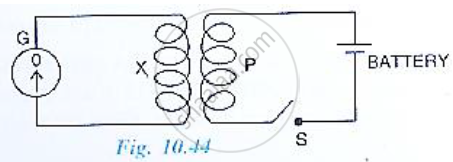
(a) Describe the observation when the switch S is (i) closed suddenly, (ii) then kept closed, (iii) finally opened.
(b) Name and state the law which explains the above observations.
For what purpose are the transformers used? Can they be used with a direct current source?
The secondary windings of a transformer in which the voltage is stepped down are usually made of thicker wire than the primary. Explain why.
In a transformer, the frequency of A.C. voltage ______.
Mention the two characteristic properties of the material suitable for making core of a transformer.
State the underlying principle of a transformer. How is the large scale transmission of electric energy over long distances done with the use of transformers?
State the principle of a step-up transformer. Explain, with the help of a labeled diagram, its working ?
State the principle of working of a transformer. Can a transformer be used to step up or step down a d.c. voltage? Justify your answer.
Draw a labeled diagram of a full wave rectifier circuit. State its working principle. Show the input-output waveforms ?
The input and output voltages of a transformer are 220 V and 44V respectively. Find the current in input circuit if the output current is 2 A.
What is the ideal transformer?
State the factors on which the frequency of the alternating e.m.f. depends.
Name the principle on which functioning of a transformer depends.
The power supply to the primary coil of a transformer is 200 W. Find
(i) Current in primary coil if the e.m.f. supply to it is equal to 220V.
(ii) The number of turns in the primary coil is equal to 80 and that in secondary is 800. What is the transformation ratio?
(iii) Name the type of transformer.
(iv) What will be the output voltage?
(v) What is the current in the secondary coil for an ideal transformer?
(vi) What is the output power?
(vii) Is output and input power equal?
(viii) Compare the current flowing in a secondary coil and in a primary coil.
Applying e.m. f to primary coil is 210 V. If the number of turns in primary coil is 200 turns and that of in secondary coil is 20 turns, then find out the output voltage. Name the type of transformer.
A transformer lowers e.m.f. 220 V to 12 volts. If the number of turns in primary are 8800, how many turns are in secondary coil?
A transformer lowers e.m.f. from 220 V to 15 V. If the number of turns in primary are 3520, how many turns are in the secondary coil?
The primary and secondary coils of a transformer each have an inductance of 200 x 10-6 H. The mutual inductance between the windings is 4 x 10⁻⁶ H. What percentage of the flux from one coil reaches the other?
An ideal transformer has 100 turns in the primary and 250 turns in the secondary. The peak value of the AC is 28 V. The rms secondary voltage is nearest to ______
The primary of a transformer has 40 turns and works on 100 V and 100 W. Find a number of turns in the secondary to step up the voltage to 400 V. Also calculate the current in the secondary and primary.
What are step-up and step-down transformers?
Explain the working of the transformer.
Give the advantage of AC in long distance power transmission with an illustration.
A step-down transformer connected to the main supply of 220 V is used to operate 11V,88W lamp. Calculate
- Voltage transformation ratio and
- Current in the primary
A 200V/120V step-down transformer of 90% efficiency is connected to an induction stove of resistance 40 Ω. Find the current drawn by the primary of the transformer.
The 300 turn primary of a transformer has resistance 0.82 Ω and the resistance of its secondary of 1200 turns is 6.2 Ω. Find the voltage across the primary if the power output from the secondary at 1600V is 32 kW. Calculate the power losses in both coils when the transformer efficiency is 80%
A transformer works on the principle of ______.
Which among the following, is not a cause for power loss in a transformer?
Read the following paragraph and answer the question:

Long distance power transmissions
The large-scale transmission and distribution of electrical energy over long distances is done with the use of transformers. The voltage output of the generator is stepped up. It is then transmitted over long distances to an area sub-station near the consumers. There the voltage is stepped down. It is further stepped down at distributing sub-stations and utility poles before a power supply of 240 V reaches our homes.
If the secondary coil has a greater number of turns than the primary, ______.
Read the following paragraph and answer the question:
Long distance power transmissions
The large-scale transmission and distribution of electrical energy over long distances is done with the use of transformers. The voltage output of the generator is stepped up. It is then transmitted over long distances to an area sub-station near the consumers. There the voltage is stepped down. It is further stepped down at distributing sub-stations and utility poles before a power supply of 240 V reaches our homes.
We need to step-up the voltage for power transmission, so that ______.
Define a Transformer.
The primary coil of a transformer has 800 turns and the secondary coil has 8 turns. It is connected to a 220 V ac supply. What will be the output voltage?
For an LCR circuit, the power transferred from the driving source to the driven oscillator is P = I2Z cos φ.
- Here, the power factor cos φ ≥ 0, P ≥ 0.
- The driving force can give no energy to the oscillator (P = 0) in some cases.
- The driving force cannot syphon out (P < 0) the energy out of oscillator.
- The driving force can take away energy out of the oscillator.
The magnetic flux through a coil perpendicular to its plane is varying according to the relation Φ = (5t3 + 4t2 + 2t - 5) Weber. If the resistant of the coil is 5 ohm, then the induced current through the coil at t = 2 sec will be ______.
Two coils P and Q are kept near each other. When no current flows through coil P and current increase in coil Q at the rate 10A/s, the emf in coil P is 15mV. When coil Q carries no current and current of 1. 8A flows through coil P, the magnetic flux linked with the coil Q is ______.
Magnetic flux passing through a coil is initially 4 × 10⁻⁴ Wb. It reduces to 10% of its original value in t second. If the emf induced is 0. 72 mV then t in second is ______.
The primary coil of a transformer has 60 turns whereas its secondary coil has 3000 turns.
If a 220 V ac voltage is applied to the primary coil, how much emf is induced in the secondary coil?
The primary coil of a transformer has 60 turns whereas its secondary coil has 3000 turns.
If a current of 5A flows in the primary coil, how much current will flow in a load in the secondary coil? State the assumption you have made regarding the transformer, in this calculation.
Derive the equation for a transformer.
In an ideal transformer, the turns ratio is \[\frac {N_p}{N_s}\] = \[\frac {1}{2}\]. The ratio Vs : Vp is equal to (the symbols carry their usual meaning) ______.
