Advertisements
Advertisements
प्रश्न
Explain why an induced current must flow in such a direction so as to oppose the change producing it.
Advertisements
उत्तर
So that the mechanical energy spent in producing the change, is transformed into the electrical energy in form of induced current.
APPEARS IN
संबंधित प्रश्न
Draw a labeled diagram of a step-down transformer.
The primary coil of an ideal step-up transformer has 100 turns and the transformation ratio is also 100. The input voltage and power are 220 V and 1100 W, respectively. Calculate the
(a) number of turns in secondary
(b) current in the primary
(c) a voltage across secondary
(d) current in secondary
(e) power in secondary
Name two factors on which the magnitude of an induced e.m.f. in the secondary coil depends.
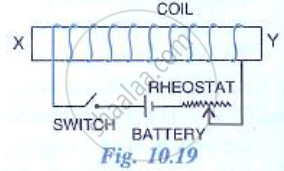
The adjacent diagram shows a coil would around a soft iron bar XY. (a) State the polarity at the end X and Y as the switch is pressed. (b) Suggest one way increasing the strength of electromagnet so formed.
Explain the construction of transformer.
Find out the phase relationship between voltage and current in a pure inductive circuit.
A 200V/120V step-down transformer of 90% efficiency is connected to an induction stove of resistance 40 Ω. Find the current drawn by the primary of the transformer.
Magnetic flux passing through a coil is initially 4 × 10⁻⁴ Wb. It reduces to 10% of its original value in t second. If the emf induced is 0. 72 mV then t in second is ______.
Efficiency of transformer is the ratio of ______.
