मराठी

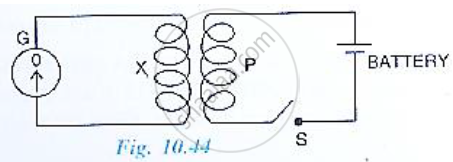
Explain why an induced current must flow in such a direction so as to oppose the change producing it.

Advertisements
Advertisements

प्रश्न

Explain why an induced current must flow in such a direction so as to oppose the change producing it.

एका वाक्यात उत्तर
Advertisements

उत्तर

So that the mechanical energy spent in producing the change, is transformed into the electrical energy in form of induced current.

shaalaa.com
  या प्रश्नात किंवा उत्तरात काही त्रुटी आहे का?
पाठ 10: Electro-Magnetism - EXERCISE-10 (C) [पृष्ठ २५८]

APPEARS IN

सेलिना Concise Physics [English] Class 10 ICSE
पाठ 10 Electro-Magnetism
EXERCISE-10 (C) | Q 13. | पृष्ठ २५८

संबंधित प्रश्‍न

What type of current is transmitted from the power station?


How is the e.m.f. across primary and secondary coils of a transformer related with the number of turns of the coil in them?


The adjacent diagram shows a coil would around a soft iron bar XY. (a) State the polarity at the end X and Y as the switch is pressed. (b) Suggest one way increasing the strength of electromagnet so formed.


The input and output voltages of a transformer are 220 V and 44V respectively. Find the current in input circuit if the output current is 2 A.


Explain step up and step down transformer?


A 200V/120V step-down transformer of 90% efficiency is connected to an induction stove of resistance 40 Ω. Find the current drawn by the primary of the transformer.


Read the following paragraph and answer the question:


Long distance power transmissions

The large-scale transmission and distribution of electrical energy over long distances is done with the use of transformers. The voltage output of the generator is stepped up. It is then transmitted over long distances to an area sub-station near the consumers. There the voltage is stepped down. It is further stepped down at distributing sub-stations and utility poles before a power supply of 240 V reaches our homes.

A power transmission line feeds input power at 2300 V to a step down transformer with its primary windings having 4000 turns. The number of turns in the secondary in order to get output power at 230 V are ______.


A transformer is essentially an a.c. device. It cannot work on d.c. It changes alternating voltages or currents. It does not affect the frequency of a.c. It is based on the phenomenon of mutual induction. A transformer essentially consists of two coils of insulated copper wire having different numbers of turns and wound on the same soft iron core.

The number of turns in the primary and secondary coils of an ideal transformer is 2000 and 50 respectively. The primary coil is connected to a main supply of 120 V and secondary coil is connected to a bulb of resistance 0.6 Ω.

Power in primary coil is ______.


The self-inductance of a closely wound coil of 200 turns is 10 mH. Determine the value of magnetic flux through the cross-section of the coil when the current passing through the coil is 4 mA.


An ideal transformer converts 170 V a.c. to 1.70 KV a.c. to transmit a power of 3.4 KW. If primary coil has 500 turns then alternating current in secondary coil is ______.


Share
Notifications

Englishहिंदीमराठी


      Forgot password?
Use app×