Advertisements
Advertisements
प्रश्न
A 200V/120V step-down transformer of 90% efficiency is connected to an induction stove of resistance 40 Ω. Find the current drawn by the primary of the transformer.
Advertisements
उत्तर
Given data:
Vp = 200 V
Vs = 120 V
η = 90% = `90/100` = 0.9
`η = "output power"/"input power"`
`therefore 0.9 = ("V"_"S""I"_"S")/("V"_"p""I"_"p")`
`therefore "V"_"S" = "I"_"S""R"_"S"`
`"I"_"S" = "V"_"S"/"R"_"S" = 120/40` = 3A
∴ 0.9 = `(120 xx 3)/(200 xx "I"_"p")`
`"I"_"p" = (120 xx 3)/(200 xx 0.9) = (120 xx 3)/(20 xx 9)`
`"I"_"p"` = 2 A
APPEARS IN
संबंधित प्रश्न
You are required to make an electromagnet from a soft iron bar by using a cell, an insulated coil of copper wire and a switch. (a) Draw a circuit diagram to represent the process. (b) label the poles of the electromagnet.
Complete the following sentence :
……… energy is converted into …………energy by an electric motor.
The following diagram in Fig. 10.44 shows a coil X connected to a sensitive centre –zero galvanometer G and a coil P connected to a battery through a switch S.
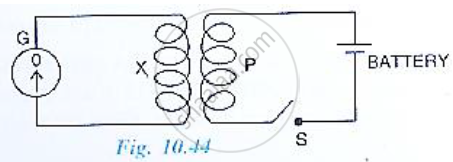
(a) Describe the observation when the switch S is (i) closed suddenly, (ii) then kept closed, (iii) finally opened.
(b) Name and state the law which explains the above observations.
Name three losses of energy in a transformer. How are they minimized?
Explain step up and step down transformer?
A 60 W load is connected to the secondary of a transformer whose primary draws line voltage. If a current of 0.54 A flows in the load, what is the current in the primary coil? Comment on the type of transformer being used.
A transformer operating at primary voltage 8 kV and secondary voltage 160 V serves a load of 80 kW. Assuming the transformer to be ideal with purely resistive load and working on unity power factor, the loads in the primary and secondary circuit would be:
A transformer consisting of 300 turns in the primary and 150 turns in the secondary gives output power of 2.2 kW. If the current in the secondary coil is 10 A, then the input voltage and current in the primary coil are ______.
Two coils P and Q are kept near each other. When no current flows through coil P and current increase in coil Q at the rate 10A/s, the emf in coil P is 15mV. When coil Q carries no current and current of 1. 8A flows through coil P, the magnetic flux linked with the coil Q is ______.
An iron rod is placed parallel to magnetic field of intensity 2000 Am-1. The magnetic flux through the rod is 6 × 10⁻⁴ Wb and its cross-sectional area is 3 cm2. The magnetic permeability of the rod in Wb A-1m-1 is ______.
