Advertisements
Advertisements
प्रश्न
Derive the equation for a transformer.
Advertisements
उत्तर
Let NP and Ns be the number of turns of the primary and secondary coils. Let Φ be the magnetic flux linked per turn.
Φp = NpΦ
= Total magnetic flux linked with the primary coil at certain instant,
Φs = NsΦ
= Total magnetic flux linked with the secondary coil at a certain instant.
By Faraday and Lenz's laws,
Induced emf in the primary coil (ep) is given by
`e_p = -(dphi_p)/dt`
= `-N_p(dphi)/dt` ...(i)
emf induced in the secondary coil (es) is
`e_s = -(dphi_s)/dt`
= `-N_s(dphi)/dt` ...(ii)
Dividing equation (ii) by equation (i),
`e_s/e_p = N_s/N_p` ...(iii)
The ratio `N_s/N_p` is called the turn ratio.
For an ideal transformer,
Input power = Output Power
epIp = esIs
`e_s/e_p = I_p/I_s` ...(iv)
From equations (iii) and (iv),
`e_s/e_p = N_s/N_p = I_p/I_s` ...(v)
APPEARS IN
संबंधित प्रश्न
State the principle on which transformer works.
Write the function of a transformer.
Express the turn ratio in terms of voltages.
Mention various energy losses in transformer device
The primary coil of an ideal step-up transformer has 100 turns and the transformation ratio is also 100. The input voltage and power are 220 V and 1100 W, respectively. Calculate the
(a) number of turns in secondary
(b) current in the primary
(c) a voltage across secondary
(d) current in secondary
(e) power in secondary
Name the transformer used in the power transmitting station of a power plant.
What type of current is transmitted from the power station?
Name two factors on which the magnitude of an induced e.m.f. in the secondary coil depends.
How is the e.m.f. across primary and secondary coils of a transformer related with the number of turns of the coil in them?
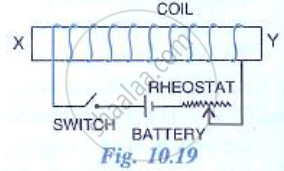
The adjacent diagram shows a coil would around a soft iron bar XY. (a) State the polarity at the end X and Y as the switch is pressed. (b) Suggest one way increasing the strength of electromagnet so formed.
The following diagram in Fig. 10.44 shows a coil X connected to a sensitive centre –zero galvanometer G and a coil P connected to a battery through a switch S.
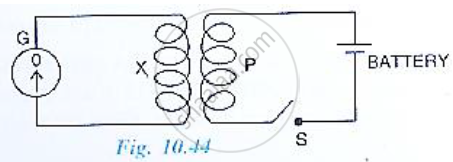
(a) Describe the observation when the switch S is (i) closed suddenly, (ii) then kept closed, (iii) finally opened.
(b) Name and state the law which explains the above observations.
For what purpose are the transformers used? Can they be used with a direct current source?
The input and output voltage of a transformer are 220 V and 44 V respectively. Find: the turns ratio.
Given the input current 15 A and the input voltage of 100 V for a step-up transformer having 90% efficiency, find the output power and the voltage in the secondary if the output current is 3 A.
State the underlying principle of a transformer. How is the large scale transmission of electric energy over long distances done with the use of transformers?
Describe briefly, with the help of labelled diagram, working of a step-up transformer.
A step-up transformer converts a low voltage into high voltage. Does it not violate the principle of conservation of energy? Explain.
The input and output voltages of a transformer are 220 V and 44V respectively. Find the current in input circuit if the output current is 2 A.
An a.c generator generates an emf 'ε' where ε = 314 Sin (50πt) volt. Calculate the frequency of emf ε.
What is the ideal transformer?
Applying e.m. f to primary coil is 210 V. If the number of turns in primary coil is 200 turns and that of in secondary coil is 20 turns, then find out the output voltage. Name the type of transformer.
A transformer lowers e.m.f. 220 V to 12 volts. If the number of turns in primary are 8800, how many turns are in secondary coil?
A transformer lowers e.m.f. from 220 V to 15 V. If the number of turns in primary are 3520, how many turns are in the secondary coil?
The primary and secondary coils of a transformer each have an inductance of 200 x 10-6 H. The mutual inductance between the windings is 4 x 10⁻⁶ H. What percentage of the flux from one coil reaches the other?
What is Transformer?
Explain step up and step down transformer?
Describe the construction and working of a transformer with a neat labelled diagram.
What are step-up and step-down transformers?
Mention the various energy losses in a transformer.
A 200V/120V step-down transformer of 90% efficiency is connected to an induction stove of resistance 40 Ω. Find the current drawn by the primary of the transformer.
A step-up transformer has 300 turns of primary winding and 450 turns of secondary winding. A primary is connected to 150 V and the current flowing through it is 9A. The current and voltage in the secondary are
A transformer having efficiency of 80% is working on 200 V and 6 kW power supply. If the current in the secondary coil is 6 A, the voltage across the secondary coil and the current in the primary coil respectively are ____________.
A 100% efficient transformer has 100 turns in the primary and 50 turns in its secondary coil. If the current in the secondary coil is 6 A, then the current in the primary coil is ______.
A transformer works on the principle of ______.
Read the following paragraph and answer the question:

Long distance power transmissions
The large-scale transmission and distribution of electrical energy over long distances is done with the use of transformers. The voltage output of the generator is stepped up. It is then transmitted over long distances to an area sub-station near the consumers. There the voltage is stepped down. It is further stepped down at distributing sub-stations and utility poles before a power supply of 240 V reaches our homes.
We need to step-up the voltage for power transmission, so that ______.
The primary coil of a transformer has 800 turns and the secondary coil has 8 turns. It is connected to a 220 V ac supply. What will be the output voltage?
A transformer is used ______
Electrical energy is transmitted over large distances at high alternating voltages. Which of the following statements is (are) correct?
- For a given power level, there is a lower current.
- Lower current implies less power loss.
- Transmission lines can be made thinner.
- It is easy to reduce the voltage at the receiving end using step-down transformers.
In a transformer, number of turns in the primary coil are 140 and that in the secondary coil are 280. If current in primary coil is 4 A, then that in the secondary coil is ______.
Two coils P and Q are kept near each other. When no current flows through coil P and current increase in coil Q at the rate 10A/s, the emf in coil P is 15mV. When coil Q carries no current and current of 1. 8A flows through coil P, the magnetic flux linked with the coil Q is ______.
Efficiency of transformer is the ratio of ______.
The primary coil of a transformer has 60 turns whereas its secondary coil has 3000 turns.
If a current of 5A flows in the primary coil, how much current will flow in a load in the secondary coil? State the assumption you have made regarding the transformer, in this calculation.
For what purpose are the transformers used?
In an ideal transformer, the turns ratio is \[\frac {N_p}{N_s}\] = \[\frac {1}{2}\]. The ratio Vs : Vp is equal to (the symbols carry their usual meaning) ______.
A step down transformer connected to an AC mains supply of 220 V is made to operate at 11 V, 44 W lamp. Ignoring power losses in the transformer, what is the current in the primary circuit?
A 12 V, 60 W lamp is connected to 220 V AC via an ideal transformer. Find the primary current.
In an ideal transformer, the turns ratio is `N_p/N_s = 1/2`. The ratio Vs : Vp is equal to (the symbols carry their usual meaning):
On the basis of winding, what are the two types of transformers?
How is the laminated soft iron core made?
Where is alternating voltage \[V_p\] applied?
What is the induced EMF in the primary coil?
