Advertisements
Advertisements
प्रश्न
Why is the core of a transformer made of soft iron?
Advertisements
उत्तर
The core of a transformer is made of soft iron because it has high permeability, so it provides complete linkage of the magnetic flux of the primary coil to the secondary coil. Secondly, the hysteresis loss of energy in soft iron is less.
APPEARS IN
संबंधित प्रश्न
A transformer converts 240 V AC to 60 V AC. The secondary has 75 turns. The number of turns in primary are _______.
(A) 600
(B) 500
(C) 400
(D) 300
Which coil of a step up transformer is made thicker and why?
On which type of current do transformers work?
The following diagram in Fig.10.42 shows a coil of several turns of copper wire connected to a sensitive centre zero galvanometer G near a magnet NS. The coil is free to move in the direction shown in the diagram.
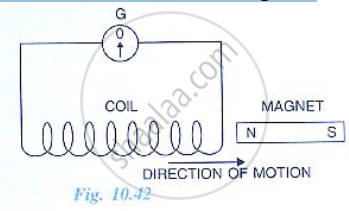
(i) Describe the observation if the coil is rapidly moved.
(ii) How would the observation be altered if (a) the coil has twice as many turns (b the coil was made to move three times as fast?
How are the e.m.f in the primary and secondary coils of a transformer related with the number of turns in these coils?
The transformer is used in ______ current circuits.
An ideal transformer has 100 turns in the primary and 250 turns in the secondary. The peak value of the AC is 28 V. The rms secondary voltage is nearest to ______
A transformer works on the principle of ______.
Read the following paragraph and answer the question:

Long distance power transmissions
The large-scale transmission and distribution of electrical energy over long distances is done with the use of transformers. The voltage output of the generator is stepped up. It is then transmitted over long distances to an area sub-station near the consumers. There the voltage is stepped down. It is further stepped down at distributing sub-stations and utility poles before a power supply of 240 V reaches our homes.
If the secondary coil has a greater number of turns than the primary, ______.
Draw the effective equivalent circuit of the circuit shown in figure, at very high frequencies and find the effective impedance.

A transformer operating at primary voltage 8 kV and secondary voltage 160 V serves a load of 80 kW. Assuming the transformer to be ideal with purely resistive load and working on unity power factor, the loads in the primary and secondary circuit would be:
The primary coil having NP turns of an ideal transformer is supplied with an alternating voltage VP. Obtain an expression for the voltage VS induced in its secondary coil having NS turns.
Mention two main sources of power loss in real transformers.
A step down transformer connected to an ac mains supply of 220 V is made to operate at 11 V, 44 W lamp. Ignoring power losses in the transformer, what is the current in the primary circuit?
On which principle is a transformer based?
Which law relates the changing flux to the EMF induced in both coils?
What is the induced EMF in the primary coil?
For an ideal transformer with \[\frac{V_s}{V_p}=3\], what is \[\frac{I_p}{I_s}\]?
