Advertisements
Advertisements
प्रश्न
Describe briefly, with the help of labelled diagram, working of a step-up transformer.
A step-up transformer converts a low voltage into high voltage. Does it not violate the principle of conservation of energy? Explain.
Advertisements
उत्तर
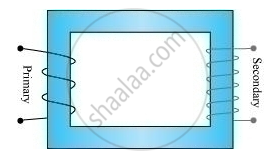
In a transformer with Ns secondary turns and Npprimary turns, induced emf or voltage Es is:
`E_s = -N_s (dphi)/dt`
Back emf = Ep =`-N_p(dphi)/(dt)`
EP = VP
Es = Vs
Thus, Vs = `-N_s (dphi)/()dt`… (1)
`V_p =-N_p (dphi)/dt ... (2)`
Dividing equations (i) and (ii), we obtain
`(V_s)/(V_p) = N_s/N_p`
If the transformer is 100% efficient, then
`i_p v_p = i_s v_s` = Power (p)
Thus, combining the above equations,
`i_p/i_s = v_s/v_p = N_s/N_p`
Or,
`V_s = (N_s/N_p)V_p and I_s = (N_p/N_s) I_p`
If Ns > Np, then the transformer is said to be step-up transformer because the voltage is stepped up in the secondary coil.
No, the transformer does not violate the principal of conservation of energies. This can be easily observed by the following equation:
`V_s I_s =V_pI_p`
Power consumed in both the coils is the same as even if the voltage increases or current increases, their product at any instant remains the same.
APPEARS IN
संबंधित प्रश्न
The secondary windings of a transformer in which the voltage is stepped down are usually made of thicker wire than the primary. Explain why.
Describe, with the help of a suitable diagram, the working principle of a step-up transformer. Obtain the relation between input and output voltages in terms of the number of turns of primary and secondary windings and the currents in the input and output circuits.
Given the input current 15 A and the input voltage of 100 V for a step-up transformer having 90% efficiency, find the output power and the voltage in the secondary if the output current is 3 A.
(i) Draw a clear labelled diagram of an electric bell.
(ii) Explain in brief, its working.
(iii) What material is used for the core of an electric bell? State the reason.
Applying e.m. f to primary coil is 210 V. If the number of turns in primary coil is 200 turns and that of in secondary coil is 20 turns, then find out the output voltage. Name the type of transformer.
Read the following paragraph and answer the question:

Long distance power transmissions
The large-scale transmission and distribution of electrical energy over long distances is done with the use of transformers. The voltage output of the generator is stepped up. It is then transmitted over long distances to an area sub-station near the consumers. There the voltage is stepped down. It is further stepped down at distributing sub-stations and utility poles before a power supply of 240 V reaches our homes.
We need to step-up the voltage for power transmission, so that ______.
Read the following paragraph and answer the question:
Long distance power transmissions
The large-scale transmission and distribution of electrical energy over long distances is done with the use of transformers. The voltage output of the generator is stepped up. It is then transmitted over long distances to an area sub-station near the consumers. There the voltage is stepped down. It is further stepped down at distributing sub-stations and utility poles before a power supply of 240 V reaches our homes.
A power transmission line feeds input power at 2300 V to a step down transformer with its primary windings having 4000 turns. The number of turns in the secondary in order to get output power at 230 V are ______.
Define a Transformer.
The line that draws power supply to your house from street has ______.
- zero average current.
- 220 V average voltage.
- voltage and current out of phase by 90°.
- voltage and current possibly differing in phase `phi` such that `|phi| < pi/2`.
Derive the equation for a transformer.
