Advertisements
Advertisements
Question
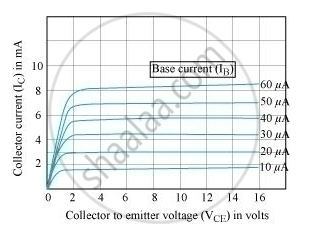
Draw a circuit diagram to study the input and output characteristics of an n-p-n transistor in its common emitter configuration. Draw the typical input and output characteristics.
Advertisements
Solution


APPEARS IN
RELATED QUESTIONS
A student wants to use two p-n junction diodes to convert alternating current into direct current. Draw the labelled circuit diagram she would use and explain how it works.
The diffusion current in a p-n junction is
In a p-n junction with open ends,
(a) there is no systematic motion of charge carries
(b) holes and conduction electrons systematically go from the p-side to n-side and from the n-side to p-side respectively
(c) there is no net charge transfer between the two sides
(d) there is a constant electric field near the junction.
In a p-n junction, a potential barrier of 250 meV exists across the junction. A hole with a kinetic energy of 300 meV approaches the junction. Find the kinetic energy of the hole when it crosses the junction if the hole approached the junction (a) from the p-side and (b) from the n-side.
If in a p-n junction diode, a square input signal of 10 V is applied as shown Then the output signal across RL will be ______

When p-type and n-type regions are formed in a single crystal, which carriers initially diffuse from each side?
In which direction is the electric field established by the fixed ions?
What is the use of diodes in power supplies and chargers?
Which semiconductor devices use the p-n junction principle?
Which formula gives the dynamic resistance of a diode?
