Advertisements
Advertisements
Question
A diode, a resistor and a 50 Hz AC source are connected in series. The number of current pulses per second through the resistor is __________ .
Options
25
50
100
200
Advertisements
Solution
50
The number of current pulses is equal to the frequency of the AC source because one current pulse passes through the diode for one oscillation of the AC source.
APPEARS IN
RELATED QUESTIONS
Explain, with the help of a circuit diagram, the working of a photo-diode. Write briefly how it is used to detect the optical signals.
Explain, with the help of a circuit diagram, the working of n-p-n transistor as a common emitter amplifier.
The drift current in a p-n junction is
In a p-n junction with open ends,
(a) there is no systematic motion of charge carries
(b) holes and conduction electrons systematically go from the p-side to n-side and from the n-side to p-side respectively
(c) there is no net charge transfer between the two sides
(d) there is a constant electric field near the junction.
The potential barrier existing across an unbiased p-n junction is 0.2 volt. What minimum kinetic energy a hole should have to diffuse from the p-side to the n-side if (a) the junction is unbiased, (b) the junction is forward-biased at 0.1 volt and (c) the junction is reverse-biased at 0.1 volt?
In a p-n junction, a potential barrier of 250 meV exists across the junction. A hole with a kinetic energy of 300 meV approaches the junction. Find the kinetic energy of the hole when it crosses the junction if the hole approached the junction (a) from the p-side and (b) from the n-side.
The drift current in a p-n junction is 20.0 µA. Estimate the number of electrons crossing a cross section per second in the depletion region.
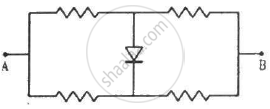
Each of the resistance shown in figure has a value of 20 Ω. Find the equivalent resistance between A and B. Does it depend on whether the point A or B is at higher potential?
Find the currents through the resistance in the circuits shown in figure.
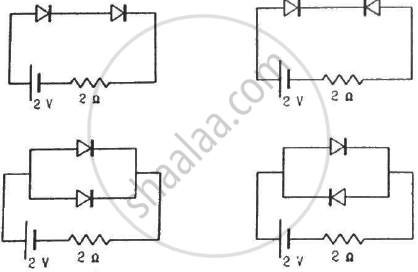
(Assume that the resistance of each diode is zero in forward bias and is infinity in reverse bias.)
Draw the current-voltage characteristics for the device show in figure between the terminals A and B.
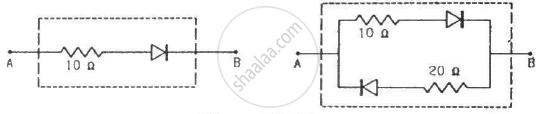
(Assume that the resistance of each diode is zero in forward bias and is infinity in reverse bias.)
If in a p-n junction diode, a square input signal of 10 V is applied as shown Then the output signal across RL will be ______

p-n junction diode is formed
The formation of the depletion region in a p-n junction diode is due to ______.
What is the depletion region?
What is dynamic resistance?
How is a true p-n junction created instead of physically joining separate semiconductor pieces?
What is the use of diodes in power supplies and chargers?
What role do diodes perform in electronic switching?
In which circuits are diodes used for signal detection?
Which formula gives the dynamic resistance of a diode?
