Advertisements
Advertisements
Question
A student wants to use two p-n junction diodes to convert alternating current into direct current. Draw the labelled circuit diagram she would use and explain how it works.
Advertisements
Solution
The student will use a full wave rectifier.
Two diodes are used to give rectified O/P corresponding to both positive as well as negative half cycles.
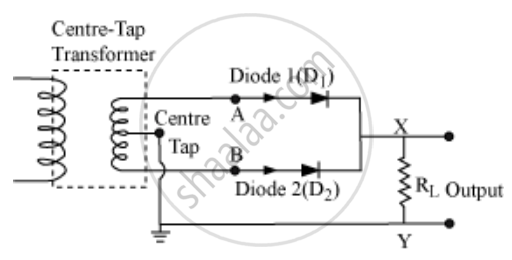
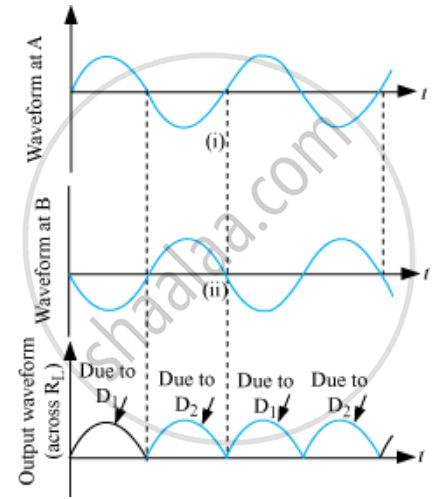
When the voltage at A with respect to the centre tap is positive, and the voltage at B is negative. Then, D1 is forward biased and D2 is reversed biased. Hence, D1 conducts and D2 does not.
When the voltage of A becomes negative, then B becomes + ve. Therefore, D1 does not conduct and D2 conducts. Hence, we obtain output voltage during both the positive as well as negative half of cycle.
APPEARS IN
RELATED QUESTIONS
The diffusion current in a p-n junction is
A hole diffuses from the p-side to the n-side in a p-n junction. This means that
The current−voltage characteristic of an ideal p-n junction diode is given by \[i = i_0 ( e^{eV/KT} - 1)\] where, the drift current i0 equals 10 µA. Take the temperature T to be 300 K. (a) Find the voltage V0 for which \[e^{eV/kT} = 100 .\]One can neglect the term 1 for voltages greater than this value. (b) Find an expression for the dynamic resistance of the diode as a function of V for V > V0. (c) Find the voltage for which the dynamic resistance is 0.2 Ω.
(Use Planck constant h = 4.14 × 10⁻¹⁵ eV-s, Boltzmann constant k = 8·62 × 10-5 eV/K.)
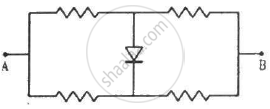
Each of the resistance shown in figure has a value of 20 Ω. Find the equivalent resistance between A and B. Does it depend on whether the point A or B is at higher potential?
A diode, a resistor and a 50 Hz AC source are connected in series. The number of current pulses per second through the resistor is __________ .
Zener breakdown occurs in a p-n junction having p and n both:
The formation of the depletion region in a p-n junction diode is due to ______.
What is the depletion region?
In which direction is the electric field established by the fixed ions?
Which semiconductor devices use the p-n junction principle?
