Advertisements
Advertisements
Question
The diffusion current in a p-n junction is
Options
from the n-side ot the p-side
from the p-side to the n-side
from the n-side to the p-side if the junction is forward-biased and in the opposite direction if it is reverse-biased
from the p-side to the n-side if the junction is forward and in the opposite direction if it is reverse-biased.
Advertisements
Solution
from the p-side to the n-side
When a p‒n junction is formed then because of the difference in the concentration of charge carriers in the two regions, electrons from the n region move to the p region and holes from the p region move to the n region. Since the direction of the current is always opposite to the motion of electron, the direction of the current is from the p side to the n side.
Similarly, when the junction is forward biassed, the positive terminal of the battery is connected to the p side of the p‒n junction and the negative terminal of the battery is connected to the n side of the p‒n junction. As a result, electrons in the n side of the p‒njunction are repelled by the negative terminal of the battery and they move to the p side, where the positive terminal of the battery attracts them. Similarly, holes from the p side of the p‒n junction are repelled by the positive terminal of the battery and they move to the n side, where the negative terminal of the battery attracts them. Thus, they give diffusion current from the p side to the n side across the p‒n junction.
In reverse biassing, there is no flow of majority carriers across the junction; hence, there is not diffusion current. Here, the flow of majority carriers is opposed by the applied voltage.
APPEARS IN
RELATED QUESTIONS
Explain briefly with the help of necessary diagrams, the reverse biasing of a p-n junction diode. Also draw characteristic curves.
A student wants to use two p-n junction diodes to convert alternating current into direct current. Draw the labelled circuit diagram she would use and explain how it works.
A hole diffuses from the p-side to the n-side in a p-n junction. This means that
In a p.n junction, the depletion region is 400 nm wide and an electric field of 5 × 10⁵ V m−1 exists in it. (a) Find the height of the potential barrier. (b) What should be the minimum kinetic energy of a conduction electron which can diffuse from the n-side to the p-side?
In a p-n junction, a potential barrier of 250 meV exists across the junction. A hole with a kinetic energy of 300 meV approaches the junction. Find the kinetic energy of the hole when it crosses the junction if the hole approached the junction (a) from the p-side and (b) from the n-side.
The drift current in a p-n junction is 20.0 µA. Estimate the number of electrons crossing a cross section per second in the depletion region.
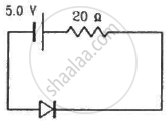
Calculate the current through the circuit and the potential difference across the diode shown in figure. The drift current for the diode is 20 µA.
A load resistor of 2kΩ is connected in the collector branch of an amplifier circuit using a transistor in common-emitter mode. The current gain β = 50. The input resistance of the transistor is 0.50 kΩ. If the input current is changed by 50µA. (a) by what amount does the output voltage change, (b) by what amount does the input voltage change and (c) what is the power gain?
Choose the correct option.
Current through a reverse-biased p-n junction increases abruptly at:
Answer in detail.
Discuss the effect of external voltage on the width of depletion region of a p-n junction.
Zener breakdown occurs in a p-n junction having p and n both:
What is barrier potential?
In which direction is the electric field established by the fixed ions?
Why does microscopic roughness prevent a proper crystal lattice from forming between separate p-type and n-type slabs?
What is the use of diodes in power supplies and chargers?
What role do diodes perform in electronic switching?
In which circuits are diodes used for signal detection?
Which formula gives the static resistance of a diode?
Which formula gives the dynamic resistance of a diode?
