Advertisements
Advertisements
Question
The drift current in a p-n junction is
Options
from the n-side to the p-side
from the p-side to the n-side
from the p-side to the side if the junction is forward-biased and the opposite direction if it is reverse-biased
from the p-side to the n-side if the junction is forward-baised and in the opposite direction if it is reverse-biased.
Advertisements
Solution
from the n-side to the p-side
After the diffusion of majority charge carriers across a p‒n junction, an electric field is set up because of the accumulation of immobile ions at the junction. These further oppose the motion of majority charge carriers across the junction. As a result, electrons from the p region start moving to the n region and holes from the n region start moving to the p region. This constitutes the drift current. As the direction of the current is opposite to the direction of the motion of the electrons, the direction of the drift current is from the n side to the p side.
In forward biasing, there is no movement of electrons from the p region to the n region and of holes from the n region to the p region. Hence, there is not drift current.
APPEARS IN
RELATED QUESTIONS
In an unbiased p-n junction, holes diffuse from the p-region to n-region because ______.
Explain briefly with the help of necessary diagrams, the forward biasing of a p-n junction diode. Also draw characteristic curves.
Explain briefly with the help of necessary diagrams, the reverse biasing of a p-n junction diode. Also draw characteristic curves.
If the two ends of a p-n junction are joined by a wire,
In a p.n junction, the depletion region is 400 nm wide and an electric field of 5 × 10⁵ V m−1 exists in it. (a) Find the height of the potential barrier. (b) What should be the minimum kinetic energy of a conduction electron which can diffuse from the n-side to the p-side?
In a p-n junction, a potential barrier of 250 meV exists across the junction. A hole with a kinetic energy of 300 meV approaches the junction. Find the kinetic energy of the hole when it crosses the junction if the hole approached the junction (a) from the p-side and (b) from the n-side.
Consider a p-n junction diode having the characteristic \[i - i_0 ( e^{eV/kT} - 1) \text{ where } i_0 = 20\mu A\] . The diode is operated at T = 300 K . (a) Find the current through the diode when a voltage of 300 mV is applied across it in forward bias. (b) At what voltage does the current double?
Calculate the current through the circuit and the potential difference across the diode shown in figure. The drift current for the diode is 20 µA.
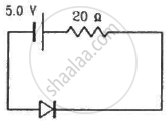
Find the currents through the resistance in the circuits shown in figure.
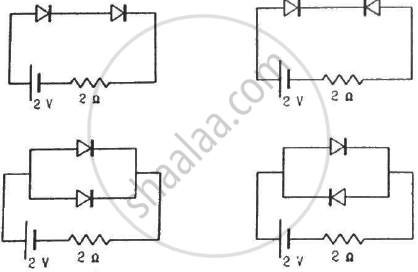
(Assume that the resistance of each diode is zero in forward bias and is infinity in reverse bias.)
Find the current through the battery in each of the circuits shown in figure.
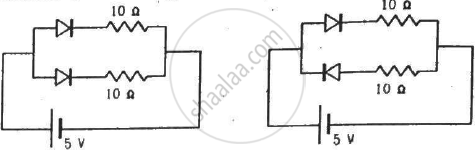
(Assume that the resistance of each diode is zero in forward bias and is infinity in reverse bias.)
If in a p-n junction diode, a square input signal of 10 V is applied as shown Then the output signal across RL will be ______

p-n junction diode is formed
For an ideal diode, in forward and reverse biased condition the resistance is respectively ______.
Which process moves charge carriers from a higher concentration to a lower concentration?
What is drift?
When p-type and n-type regions are formed in a single crystal, which carriers initially diffuse from each side?
What is the use of diodes in power supplies and chargers?
Which formula gives the static resistance of a diode?
