Advertisements
Advertisements
Question
How is a zener diode fabricated so as to make it a special purpose diode? Draw I-V characteristics of zener diode and explain the significance of breakdown voltage.
Explain briefly, with the help of a circuit diagram, how a p-n junction diode works as a half wave rectifier.
Advertisements
Solution
Zener is fabricated such that both the p-type and the n-type are highly doped. This makes the depletion region thin. When an electric field is applied, a high electric field appears across the thin depletion region. When the electric field becomes very high, it knocks off electrons from the host atoms to create a large number of electrons. This results in a large value of current inside the circuit.
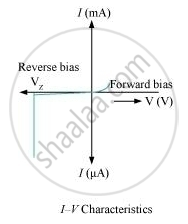
Zener has a sharp breakdown voltage and this property of zener is used for voltage regulation.
An ac current has a positive half cycle and a negative half cycle. A pn junction allows current to pass only in one direction and that is when it is forward biased.
When a positive half-cycle occurs, the p-side has a lower potential. Therefore, the diode is now forward biased and therefore conducts and this positive cycle is available for the load.
When a negative half cycle occurs, the n-side has a higher potential than the p-side. Hence, the diode is now reverse biased and thus, does not conduct. As a result, this positive half cycle also does not conduct. Therefore, it does not appear at the load and is cut-off.
We obtain a waveform, which has only positive half cycles and therefore it is called half-wave rectifier.
APPEARS IN
RELATED QUESTIONS
In a p-n junction diode, the current I can be expressed as
I = `"I"_0 exp ("eV"/(2"k"_"BT") - 1)`
where I0 is called the reverse saturation current, V is the voltage across the diode and is positive for forward bias and negative for reverse bias, and I is the current through the diode, kBis the Boltzmann constant (8.6×10⁻⁵ eV/K) and T is the absolute temperature. If for a given diode I0 = 5 × 10⁻¹² A and T = 300 K, then
(a) What will be the forward current at a forward voltage of 0.6 V?
(b) What will be the increase in the current if the voltage across the diode is increased to 0.7 V?
(c) What is the dynamic resistance?
(d) What will be the current if reverse bias voltage changes from 1 V to 2 V?
The diffusion current in a p-n junction is
A semiconducting device is connected in a series circuit with a battery and a resistance. A current is found to pass through the circuit. If the polarity of the battery is reversed, the current drops to almost zero. the device may be
(a) an intrinsic semiconductor
(b) a p-type semiconductor
(c) an n-type semiconductor
(d) a p-n junction
The drift current in a p-n junction is 20.0 µA. Estimate the number of electrons crossing a cross section per second in the depletion region.
Find the currents through the resistance in the circuits shown in figure.
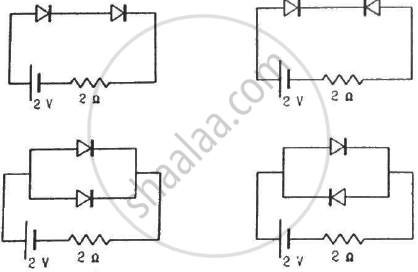
(Assume that the resistance of each diode is zero in forward bias and is infinity in reverse bias.)
A load resistor of 2kΩ is connected in the collector branch of an amplifier circuit using a transistor in common-emitter mode. The current gain β = 50. The input resistance of the transistor is 0.50 kΩ. If the input current is changed by 50µA. (a) by what amount does the output voltage change, (b) by what amount does the input voltage change and (c) what is the power gain?
The depletion layer in the p-n junction diode is caused by ______.
p-n junction diode is formed
What is barrier potential?
In which circuits are diodes used for signal detection?
