Advertisements
Advertisements
प्रश्न
How is a zener diode fabricated so as to make it a special purpose diode? Draw I-V characteristics of zener diode and explain the significance of breakdown voltage.
Explain briefly, with the help of a circuit diagram, how a p-n junction diode works as a half wave rectifier.
Advertisements
उत्तर
Zener is fabricated such that both the p-type and the n-type are highly doped. This makes the depletion region thin. When an electric field is applied, a high electric field appears across the thin depletion region. When the electric field becomes very high, it knocks off electrons from the host atoms to create a large number of electrons. This results in a large value of current inside the circuit.
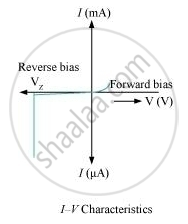
Zener has a sharp breakdown voltage and this property of zener is used for voltage regulation.
An ac current has a positive half cycle and a negative half cycle. A pn junction allows current to pass only in one direction and that is when it is forward biased.
When a positive half-cycle occurs, the p-side has a lower potential. Therefore, the diode is now forward biased and therefore conducts and this positive cycle is available for the load.
When a negative half cycle occurs, the n-side has a higher potential than the p-side. Hence, the diode is now reverse biased and thus, does not conduct. As a result, this positive half cycle also does not conduct. Therefore, it does not appear at the load and is cut-off.
We obtain a waveform, which has only positive half cycles and therefore it is called half-wave rectifier.
APPEARS IN
संबंधित प्रश्न
A zener diode is fabricated by heavily doping both p- and n- sides of the junction. Explain, why?
The drift current in a reverse-biased p-n junction is increased in magnitude if the temperature of the junction is increased. Explain this on the basis of creation of hole-electron pairs.
Diffusion current in a p-n junction is greater than the drift current in magnitude
Two identical p-n junction may be connected in series with a battery in three ways. The potential difference across the two p-n junctions are equal in

Find the equivalent resistance of the network shown in figure between the points A and B.
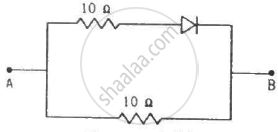
(Assume that the resistance of each diode is zero in forward bias and is infinity in reverse bias.)
During the formation of a p-n junction ______.
What is the depletion region?
Which process moves charge carriers from a higher concentration to a lower concentration?
Which charge carriers remain near the junction after the region loses mobile charge carriers?
What is the approximate knee voltage for germanium?
