Advertisements
Advertisements
प्रश्न
During the formation of a p-n junction ______.
विकल्प
diffusion current keeps increasing.
drift current remains constant.
both the diffusion current and drift current remain constant.
diffusion current remains almost constant but the drift current increases till both currents become equal.
Advertisements
उत्तर
During the formation of a p-n junction diffusion current remains almost constant but the drift current increases till both currents become equal.
संबंधित प्रश्न
In an unbiased p-n junction, holes diffuse from the p-region to n-region because ______.
Explain briefly with the help of necessary diagrams, the reverse biasing of a p-n junction diode. Also draw characteristic curves.
The drift current in a reverse-biased p-n junction is increased in magnitude if the temperature of the junction is increased. Explain this on the basis of creation of hole-electron pairs.
Diffusion current in a p-n junction is greater than the drift current in magnitude
A semiconducting device is connected in a series circuit with a battery and a resistance. A current is found to pass through the circuit. If the polarity of the battery is reversed, the current drops to almost zero. the device may be
(a) an intrinsic semiconductor
(b) a p-type semiconductor
(c) an n-type semiconductor
(d) a p-n junction
In a p-n junction, a potential barrier of 250 meV exists across the junction. A hole with a kinetic energy of 300 meV approaches the junction. Find the kinetic energy of the hole when it crosses the junction if the hole approached the junction (a) from the p-side and (b) from the n-side.
Find the current through the battery in each of the circuits shown in figure.
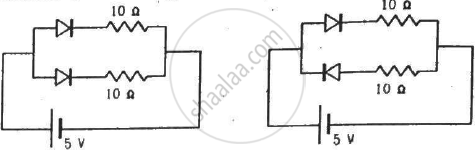
(Assume that the resistance of each diode is zero in forward bias and is infinity in reverse bias.)
An AC source is connected to a diode and a resistor in series. Is the current thorough the resistor AC or DC?
In a semiconductor diode, the barrier potential offers opposition to only ______.
What is the use of diodes in power supplies and chargers?
