Advertisements
Advertisements
प्रश्न
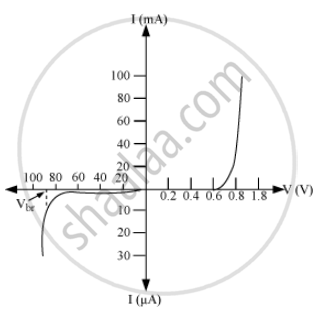
Explain briefly with the help of necessary diagrams, the reverse biasing of a p-n junction diode. Also draw characteristic curves.
Advertisements
उत्तर
p-n junction diode under reverse bias
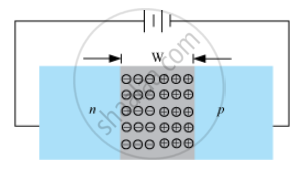
Positive terminal of battery is connected to n-side and negative terminal to p-side.
Reverse bias supports the potential barrier. Therefore, the barrier height increases and the width of depletion region also increases.
Effective barrier height under reverse bias is (V0 + V).
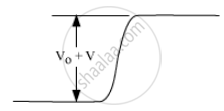
No conduction across the junction due to majority carriers; few minority carriers cross the junction after being accelerated by high reverse bias voltage
This constitutes a current that flows in opposite direction − celled reverse current.
APPEARS IN
संबंधित प्रश्न
Explain briefly with the help of necessary diagrams, the forward biasing of a p-n junction diode. Also draw characteristic curves.
Mention the important considerations required while fabricating a p-n junction diode to be used as a Light Emitting Diode (LED). What should be the order of band gap of an LED if it is required to emit light in the visible range?
Draw a circuit diagram to study the input and output characteristics of an n-p-n transistor in its common emitter configuration. Draw the typical input and output characteristics.
The drift current in a p-n junction is
Diffusion current in a p-n junction is greater than the drift current in magnitude
Find the current through the resistance R in figure if (a) R = 12Ω (b) R = 48Ω.
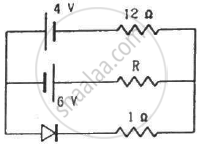
(Assume that the resistance of each diode is zero in forward bias and is infinity in reverse bias.)
What is static resistance?
In which direction is the electric field established by the fixed ions?
How is a true p-n junction created instead of physically joining separate semiconductor pieces?
What is the approximate knee voltage for silicon?
