Advertisements
Advertisements
प्रश्न
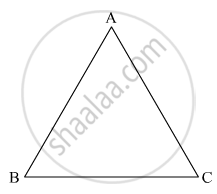
A ray of light passing from air through an equilateral glass prism undergoes minimum deviation when the angle of incidence is 3/4 th of the angle of prism. Calculate the speed of light in the prism.
A ray of light incident on face AB of an equilateral glass prism, shows minimum deviation of 30°. Calculate the speed of light through the prism.
Advertisements
उत्तर
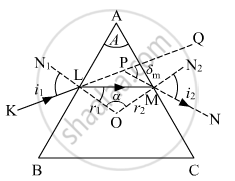
i = 3/4 A for minimum deviation we know,
A + δm = 2i
Therefore, A + δm = 2 × 3/4 A
δm = (1.5 − 1)A
⇒ δm = 0.5 A
For equilateral prism
A = 60° ...(i)
⇒ δm = 0.5 × 60° = 30° ...(ii)
Also, for minimum deviation, refractive index of glass w.r.t. air is given by
`∴μ="speed of light in air (c)"/"speed of light in prism"`...(iii)
`thereforemu=sin((A+δ_m)/2)/sin(A/2)`
`∴μ=sin((60+30)^@/2)/sin(60^@/2)`
`∴μ=sin((90^@)/2)/sin(60^@/2)` ....(iv)
using (iii) and (iv)
`∴"speed of light in prism"="speed of light in air (c)"/μ`
`∴"speed of light in prism" =sin(60^@/2)/sin(90^@/2) xx c`
`= (1/2)/(1/sqrt2)xx 3 × 10^8`
`= 3/sqrt2 × 10^8 "m/s"`
`= 2.12 × 10^8 "m/s"`
