Advertisements
Advertisements
प्रश्न
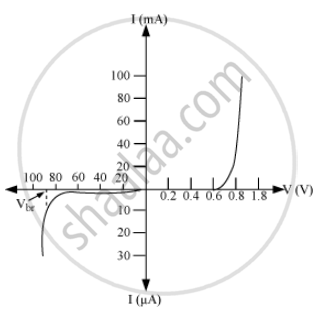
Explain briefly with the help of necessary diagrams, the reverse biasing of a p-n junction diode. Also draw characteristic curves.
Advertisements
उत्तर
p-n junction diode under reverse bias
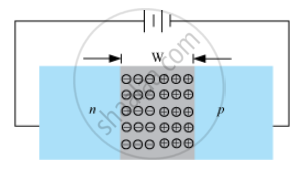
Positive terminal of battery is connected to n-side and negative terminal to p-side.
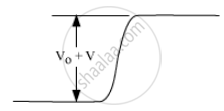
Reverse bias supports the potential barrier. Therefore, the barrier height increases and the width of depletion region also increases.
Effective barrier height under reverse bias is (V0 + V).
No conduction across the junction due to majority carriers; few minority carriers cross the junction after being accelerated by high reverse bias voltage
This constitutes a current that flows in opposite direction − celled reverse current.
APPEARS IN
संबंधित प्रश्न
Explain, with the help of a circuit diagram, the working of n-p-n transistor as a common emitter amplifier.
The drift current in a reverse-biased p-n junction is increased in magnitude if the temperature of the junction is increased. Explain this on the basis of creation of hole-electron pairs.
If the two ends of a p-n junction are joined by a wire,
The potential barrier existing across an unbiased p-n junction is 0.2 volt. What minimum kinetic energy a hole should have to diffuse from the p-side to the n-side if (a) the junction is unbiased, (b) the junction is forward-biased at 0.1 volt and (c) the junction is reverse-biased at 0.1 volt?
Consider a p-n junction diode having the characteristic \[i - i_0 ( e^{eV/kT} - 1) \text{ where } i_0 = 20\mu A\] . The diode is operated at T = 300 K . (a) Find the current through the diode when a voltage of 300 mV is applied across it in forward bias. (b) At what voltage does the current double?
A diode, a resistor and a 50 Hz AC source are connected in series. The number of current pulses per second through the resistor is __________ .
The depletion layer in the p-n junction diode is caused by ______.
What is drift?
Why does microscopic roughness prevent a proper crystal lattice from forming between separate p-type and n-type slabs?
How is a true p-n junction created instead of physically joining separate semiconductor pieces?
