Advertisements
Advertisements
प्रश्न
Consider a p-n junction diode having the characteristic \[i - i_0 ( e^{eV/kT} - 1) \text{ where } i_0 = 20\mu A\] . The diode is operated at T = 300 K . (a) Find the current through the diode when a voltage of 300 mV is applied across it in forward bias. (b) At what voltage does the current double?
Advertisements
उत्तर
(a) Given:-
Drift current, i0 = 20 × 10−6 A
Temperature, T = 300 K
Applied voltage, V = 300 mV
The variation in the current with respect to the voltage is given by
\[i = i_0 \left( e^\frac{eV}{KT} - 1 \right)\]
\[ \Rightarrow i = 20 \times {10}^{- 6} \left( e^\frac{0 . 3}{8 . 62 \times 300 \times {10}^{- 5}} - 1 \right)\]
\[ \Rightarrow i = 20 \times {10}^{- 5} \left( e^\frac{100}{8 . 61} - 1 \right)\]
\[ \Rightarrow i = 2 . 18 A \approx 2 \] A
(b) We need to find the voltage at which the current doubles so that the new value of the current becomes 4 A.
\[\Rightarrow 4 = 20 \times {10}^{- 6} \left( e^\frac{eV}{8 . 62 \times 3 \times {10}^{- 3}} - 1 \right)\]
\[ \Rightarrow e^\frac{V \times {10}^3}{8 . 62 \times 3} - 1 = \frac{4 \times {10}^6}{20}\]
\[ \Rightarrow e^\frac{V \times {10}^3}{8 . 62 \times 3} = 200001\]
\[ \Rightarrow \frac{V \times {10}^3}{8 . 62 \times 3} = 12 . 2060\]
\[ \Rightarrow V = \frac{12 . 206 \times 8 . 63 \times 3}{{10}^3}\]
\[ \Rightarrow V = 318 \] mV
APPEARS IN
संबंधित प्रश्न
In an unbiased p-n junction, holes diffuse from the p-region to n-region because ______.
When a p-type impurity is doped in a semiconductor, a large number of holes are created, This does not make the semiconductor charged. But when holes diffuse from the p-side to the n-side in a p-n junction, the n-side gets positively charged. Explain.
The drift current in a reverse-biased p-n junction is increased in magnitude if the temperature of the junction is increased. Explain this on the basis of creation of hole-electron pairs.
In a p-n junction with open ends,
(a) there is no systematic motion of charge carries
(b) holes and conduction electrons systematically go from the p-side to n-side and from the n-side to p-side respectively
(c) there is no net charge transfer between the two sides
(d) there is a constant electric field near the junction.
A semiconducting device is connected in a series circuit with a battery and a resistance. A current is found to pass through the circuit. If the polarity of the battery is reversed, the current drops to almost zero. the device may be
(a) an intrinsic semiconductor
(b) a p-type semiconductor
(c) an n-type semiconductor
(d) a p-n junction
The drift current in a p-n junction is 20.0 µA. Estimate the number of electrons crossing a cross section per second in the depletion region.
The current−voltage characteristic of an ideal p-n junction diode is given by \[i = i_0 ( e^{eV/KT} - 1)\] where, the drift current i0 equals 10 µA. Take the temperature T to be 300 K. (a) Find the voltage V0 for which \[e^{eV/kT} = 100 .\]One can neglect the term 1 for voltages greater than this value. (b) Find an expression for the dynamic resistance of the diode as a function of V for V > V0. (c) Find the voltage for which the dynamic resistance is 0.2 Ω.
(Use Planck constant h = 4.14 × 10⁻¹⁵ eV-s, Boltzmann constant k = 8·62 × 10-5 eV/K.)
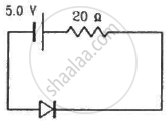
Calculate the current through the circuit and the potential difference across the diode shown in figure. The drift current for the diode is 20 µA.
Find the current through the resistance R in figure if (a) R = 12Ω (b) R = 48Ω.
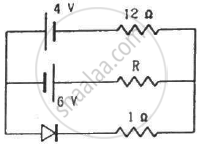
(Assume that the resistance of each diode is zero in forward bias and is infinity in reverse bias.)
A diode, a resistor and a 50 Hz AC source are connected in series. The number of current pulses per second through the resistor is __________ .
Answer in detail.
Discuss the effect of external voltage on the width of depletion region of a p-n junction.
What is the depletion region?
What is a p-n junction diode?
Which process moves charge carriers from a higher concentration to a lower concentration?
What is drift?
Why does microscopic roughness prevent a proper crystal lattice from forming between separate p-type and n-type slabs?
What is the use of diodes in power supplies and chargers?
Which semiconductor devices use the p-n junction principle?
What is the approximate knee voltage for germanium?
