Advertisements
Advertisements
Question
Consider a p-n junction diode having the characteristic \[i - i_0 ( e^{eV/kT} - 1) \text{ where } i_0 = 20\mu A\] . The diode is operated at T = 300 K . (a) Find the current through the diode when a voltage of 300 mV is applied across it in forward bias. (b) At what voltage does the current double?
Advertisements
Solution
(a) Given:-
Drift current, i0 = 20 × 10−6 A
Temperature, T = 300 K
Applied voltage, V = 300 mV
The variation in the current with respect to the voltage is given by
\[i = i_0 \left( e^\frac{eV}{KT} - 1 \right)\]
\[ \Rightarrow i = 20 \times {10}^{- 6} \left( e^\frac{0 . 3}{8 . 62 \times 300 \times {10}^{- 5}} - 1 \right)\]
\[ \Rightarrow i = 20 \times {10}^{- 5} \left( e^\frac{100}{8 . 61} - 1 \right)\]
\[ \Rightarrow i = 2 . 18 A \approx 2 \] A
(b) We need to find the voltage at which the current doubles so that the new value of the current becomes 4 A.
\[\Rightarrow 4 = 20 \times {10}^{- 6} \left( e^\frac{eV}{8 . 62 \times 3 \times {10}^{- 3}} - 1 \right)\]
\[ \Rightarrow e^\frac{V \times {10}^3}{8 . 62 \times 3} - 1 = \frac{4 \times {10}^6}{20}\]
\[ \Rightarrow e^\frac{V \times {10}^3}{8 . 62 \times 3} = 200001\]
\[ \Rightarrow \frac{V \times {10}^3}{8 . 62 \times 3} = 12 . 2060\]
\[ \Rightarrow V = \frac{12 . 206 \times 8 . 63 \times 3}{{10}^3}\]
\[ \Rightarrow V = 318 \] mV
APPEARS IN
RELATED QUESTIONS
Explain briefly with the help of necessary diagrams, the reverse biasing of a p-n junction diode. Also draw characteristic curves.
How is a zener diode fabricated so as to make it a special purpose diode? Draw I-V characteristics of zener diode and explain the significance of breakdown voltage.
Explain briefly, with the help of a circuit diagram, how a p-n junction diode works as a half wave rectifier.
The diffusion current in a p-n junction is
Diffusion current in a p-n junction is greater than the drift current in magnitude
Two identical p-n junction may be connected in series with a battery in three ways. The potential difference across the two p-n junctions are equal in

The potential barrier existing across an unbiased p-n junction is 0.2 volt. What minimum kinetic energy a hole should have to diffuse from the p-side to the n-side if (a) the junction is unbiased, (b) the junction is forward-biased at 0.1 volt and (c) the junction is reverse-biased at 0.1 volt?
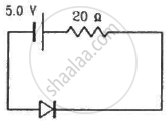
Calculate the current through the circuit and the potential difference across the diode shown in figure. The drift current for the diode is 20 µA.
What are the readings of the ammeters A1 and A2 shown in figure. Neglect the resistance of the meters.
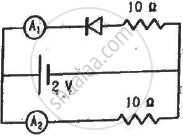
(Assume that the resistance of each diode is zero in forward bias and is infinity in reverse bias.)
Find the current through the battery in each of the circuits shown in figure.
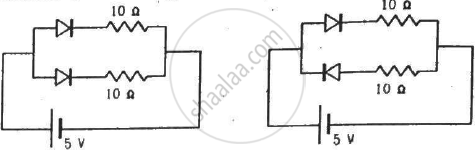
(Assume that the resistance of each diode is zero in forward bias and is infinity in reverse bias.)
Find the equivalent resistance of the network shown in figure between the points A and B.
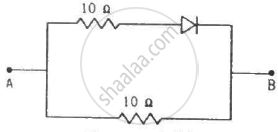
(Assume that the resistance of each diode is zero in forward bias and is infinity in reverse bias.)
When the base current in a transistor is changed from 30µA to 80µA, the collector current is changed from 1.0 mA to 3.5 mA. Find the current gain β.
A load resistor of 2kΩ is connected in the collector branch of an amplifier circuit using a transistor in common-emitter mode. The current gain β = 50. The input resistance of the transistor is 0.50 kΩ. If the input current is changed by 50µA. (a) by what amount does the output voltage change, (b) by what amount does the input voltage change and (c) what is the power gain?
p-n junction diode is formed
What is drift?
Which charge carriers remain near the junction after the region loses mobile charge carriers?
Why does microscopic roughness prevent a proper crystal lattice from forming between separate p-type and n-type slabs?
How is a true p-n junction created instead of physically joining separate semiconductor pieces?
What is the use of diodes in power supplies and chargers?
What is the net current in zero bias when diffusion and drift currents balance?
What is the approximate knee voltage for germanium?
